
Making the Right Structured Cabling Investment
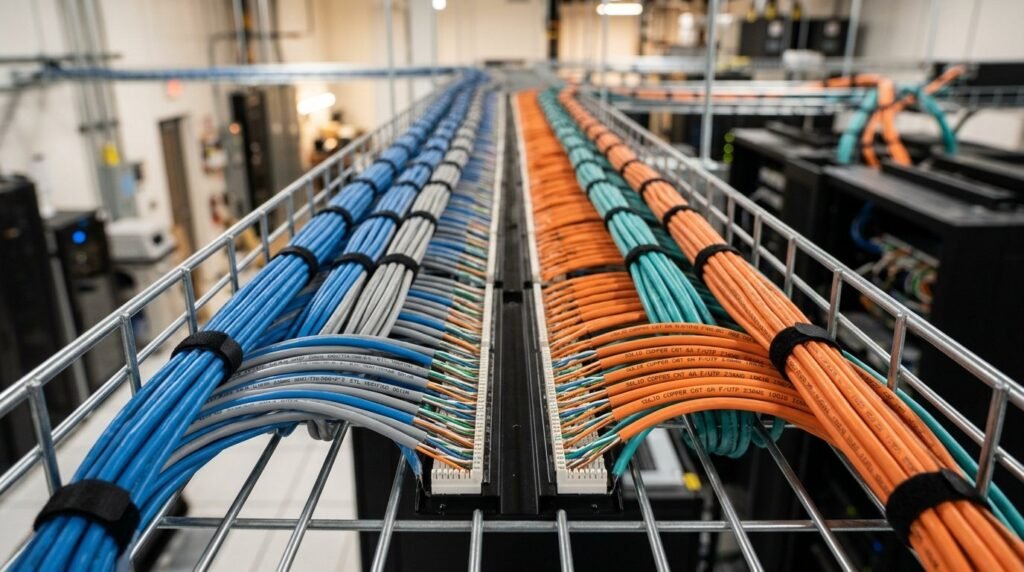
Structured cabling is the absolute physical foundation of your property’s technology infrastructure. While wireless standards change every 3–4 years and switch hardware is refreshed every 5–7 years, structured copper cabling is expected to remain in ceilings, wall cavities, and risers for 15 to 20 years.
When planning a hotel refurbishment or new venue fit-out, one of the most pivotal technical decisions is choosing between Category 6 (Cat6) and Category 6A (Cat6A). Understanding the physical and performance distinctions ensures you don’t compromise future capabilities to save minor upfront costs.
The 10-Gigabit Distance Rule
Both Cat6 and Cat6A can theoretically transmit 10Gbps Ethernet. However, standard Cat6 can only sustain 10Gbps up to approximately 37 to 55 meters in optimal conditions, whereas Cat6A guarantees full 10Gbps performance across the complete 100-meter channel length, even amidst heavy electromagnetic interference.
Direct Comparison: Cat6 vs Cat6A Specifications
| Parameter | Category 6 (Cat6) | Category 6A (Cat6A) |
|---|---|---|
| Operating Frequency | Up to 250 MHz | Up to 500 MHz |
| Max Data Rate @ 100m | 1 Gbps (10Gbps limited to <55m) | 10 Gbps Guaranteed full distance |
| Alien Crosstalk Immunity | Moderate (vulnerable in tight bundles) | Superior (internal spline + shielding) |
| Cable Diameter & Weight | Thinner (~5.5mm), easier to pull | Thicker (~7.2mm), requires larger containment |
| High-Power PoE (60W-90W) | Higher thermal dissipation in bundles | Superior heat dissipation, lower resistance |
Recommendation for Hospitality Deployments
- Deploy Cat6A for: Access point ceiling drops (to support multi-gigabit Wi-Fi 6E/7), comms room inter-cabinet links, and runs exceeding 50 meters.
- Cat6 Remains Viable for: Standard desktop VoIP phone outlets, back-office printer drops, and short horizontal runs where 1Gbps bandwidth will remain sufficient for the equipment’s lifespan.