Network & Connectivity
The infrastructure guests never see, but always feel.
Internet
FTTP, leased lines & diverse connectivity
Security
Firewalls protecting every system
Switching
FTTP, leased lines & diverse connectivity
Wi-Fi
Enterprise wireless, indoors & out
Wi-Fi

Ruckus
Regarded as the gold standard for hospitality wireless networking for many years. We've worked with the platform extensively and have consistently found it to deliver exceptional performance, reliability, and flexibility across a wide range of hospitality environments. Combined with a comprehensive range of indoor, outdoor, high-density, and hospitality-specific solutions, Ruckus remains one of our key technology partners to this day.

Cambium
Entered the enterprise Wi-Fi market to address the gap between premium enterprise solutions and lower-cost platforms that prioritised affordability over functionality. Over the last decade the platform has matured significantly, becoming one of our preferred options for organisations seeking enterprise-grade capabilities without the complexity and ongoing licensing costs often associated with traditional enterprise vendors.

Aruba & Cisco Meraki
Both well-established enterprise networking platforms with strong market adoption and an instantly recognisable brand. While not typically our first recommendation for hospitality deployments, we have extensive experience working with both platforms and maintain strong commercial relationships that allow us to support customers where Aruba or Cisco alignment is a business requirement.
Indoor access points
In-Room Access Points
Designed for deployment within guestrooms, apartments, lodges, offices and other self-contained spaces. Often installed as discreet wall plate access points, they provide reliable room-level wireless coverage whilst also supporting wired connectivity for televisions, telephones, IPTV systems, access control devices, and other room technologies.
Small Area & Back-of-House Coverage
Ideal for corridors, small reception areas, staff facilities, offices, and other lower-density spaces. These access points provide dependable wireless coverage whilst maintaining a discreet visual footprint and cost-effective deployment.
Public Areas — Food & Beverage
Designed for medium-sized public spaces where multiple users and devices are expected to connect concurrently — restaurants, bars, lounges, health clubs and other guest-facing environments.
Large Public Spaces & Conference Facilities
Suited to hotel lobbies, atriums, conference suites and exhibition spaces, where capacity, coverage, and device density become increasingly important.
High-Density & High-Capacity Environments
Designed for conference centres, event venues, lecture theatres, and function rooms. Advanced radio management, capacity optimisation, and careful design maintain performance during peak demand.
Outdoor & specialist environments
Omni-Directional Coverage
Designed to provide broad wireless coverage across open spaces such as courtyards, terraces, beer gardens, pool areas, and outdoor hospitality environments, distributing coverage evenly where users may move freely throughout the area.
Sectorised Coverage
Focuses wireless coverage into a specific area or direction, maximising performance where a centrally positioned access point isn't practical — particularly effective for long outdoor spaces, event areas, and building perimeters.
Indoor Applications
Despite the name, outdoor access points aren't limited to external deployments. Their ruggedised construction suits demanding indoor environments — commercial kitchens, leisure facilities, spa environments, workshops, and plant rooms.
Poor Wi-Fi is often a symptom, not the cause
- DHCP Exhaustion
- Switching Bottlenecks
- Bandwidth Contention
- Unmanaged Guest Device Behaviour
- RF Interference
- Channel Congestion
- Network Segmentation Issues
Network Infrastructure Switching
Edge & Access Switching
Provides connectivity for the devices people interact with every day, including Wi-Fi access points, telephones, televisions, CCTV cameras, workstations, and payment terminals.
Core Switching
Acts as the central hub of the network, connecting users, services, internet connectivity, security platforms, and business-critical systems together.
Power over Ethernet (PoE) Switching
Delivers both power and network connectivity over a single cable, simplifying deployments and reducing infrastructure requirements for access points, cameras, phones, access control readers, and IoT sensors.
High Availability & Stacked Switching
Provides additional resilience for environments where downtime is unacceptable, helping ensure critical services remain operational in the event of hardware failure.
Outdoor & Ruggedised Switching
Designed for challenging or exposed environments — installed within outdoor cabinets, kiosks, lighting columns and other field enclosures. Common applications include holiday parks, resorts, marinas, campuses, car parks, and distributed estates where cabling distances or site layout make conventional deployments impractical.
Network Infrastructure Switching
Typical solutions
- Entry Level Firewalls
- STANDARD
- Mid-Range Firewalls
- GROWING SITES
- High Availability Firewalls
- MISSION CRITICAL
Security isn't just for large organisations
Small and medium hospitality businesses are increasingly being targeted by cyber threats. Increasingly, cyber resilience is also becoming a commercial consideration — many organisations now require cyber security insurance, with insurers assessing the controls in place when determining coverage, policy conditions, and premiums.
Firewalls help protect critical systems such as
- EPOS
- Payment Systems
- Guest Wi-Fi
- CCTV
- Back Office Systems
- Cloud Applications
Industry Insights
Physical Infrastructure
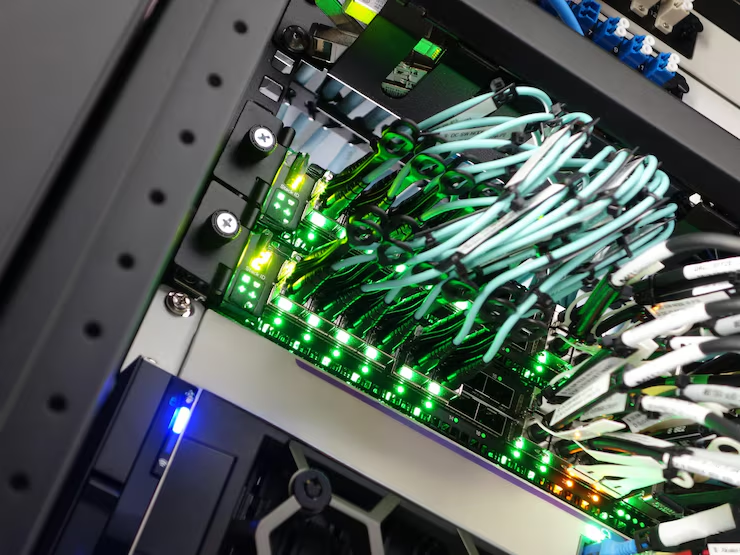
Structured Cabling
- Cat6 Cabling
- Cat6A Cabling
- Fibre Optic Cabling
- Network Testing & Certification

Cabinets & Racks
- Wall Mounted Network Cabinets
- Floor Standing Cabinets
- Communications Room Fit-Outs
- Cable Management
- Power Distribution
BUILDING NEW OR REFURBISHING?
The best time to install structured cabling is before walls, ceilings, and finishes are completed. Early engagement can significantly reduce installation costs and avoid disruptive retrofit work later in the project.
Industry Insights — Cabling
Internet Connectivity
01
FTTP
Fibre-to-the-Premises delivers internet connectivity directly over fibre optic infrastructure, providing significantly higher speeds and greater reliability than traditional copper-based broadband services. For many hospitality environments, FTTP offers an excellent balance of performance and affordability.
02
Leased Lines
Leased lines provide a dedicated connection between the property and the provider's network, ensuring bandwidth remains uncontended and consistently available. Where uptime, service guarantees, and predictable performance are business-critical, leased lines are often the preferred solution.
03
Diverse Connectivity
No internet connection is immune from failure. Diverse connectivity solutions reduce reliance on a single carrier, route, or technology, helping minimise disruption caused by outages, infrastructure failures, or service issues.
04
Wireless Backhaul
High-capacity connectivity between two fixed locations, transmitted using radio waves. Backhaul solutions are designed specifically to carry the volumes of traffic required to support entire buildings, sites, and business operations — fulfilling the same role as a fibre connection, delivering true "fibre through the air" performance without the costs, timescales, and disruption of extending traditional fibre infrastructure.
Looking to build greater resilience?
Could wireless backhaul be the smarter alternative?
Fixed Wireless Connectivity
Faster Deployment
Traditional fibre projects can take weeks or months, often requiring surveys, wayleaves, permits, road closures, trenching, and civil engineering works. Wireless backhaul can frequently be deployed in a matter of days.
Eliminate Expensive Civil Works
Crossing roads, pavements, waterways, public spaces, or privately owned land can introduce significant costs, permissions, and delays. Wireless backhaul eliminates many of these challenges while ensuring consistent, high-performance connectivity.
Carrier-Grade Performance
Modern wireless backhaul platforms deliver multi-gigabit throughput, exceptionally low latency, and availability levels comparable to many carrier services — fibre-like performance without relying on physical fibre.
Not All Wireless Is Created Equal
Specialist wireless backhaul solutions utilise dedicated spectrum and highly directional transmission paths that all but eliminate the risk of interference, enabling predictable performance even in dense urban environments.
Temporary or Permanent
Wireless backhaul can be rapidly deployed as a temporary solution while waiting for a leased line or fibre project to complete. Many organisations find the performance meets all long-term requirements.
Network Diversity & Business Continuity
Wireless backhaul can provide a completely independent network path, helping eliminate common points of failure — particularly valuable within wider business continuity and failover strategies.
Endpoint connectivity
Not every connectivity challenge involves connecting a building to the internet. Many organisations already have a reliable network connection in place, but extending that connectivity to other areas of a site can often prove challenging. Whether connecting CCTV cameras, access control systems, outdoor Wi-Fi, digital displays, or reaching locations previously considered impossible to connect, fixed wireless solutions provide a practical alternative where cabling would be impractical, disruptive, or cost-prohibitive.
The Art of the Impossible
Some connectivity challenges are quickly dismissed as impossible when traditional cabling is presented as the only viable solution. Consider a hotel car park requiring a mixture of CCTV, vehicle barriers, intercoms, digital signage, EV charging infrastructure, or outdoor Wi-Fi. Delivering that connectivity using traditional cabling means excavating the car park and reinstating everything once the work is complete — guests and staff must navigate around ongoing works, and a simple technology deployment quickly becomes a significant infrastructure project.
This challenge isn't exclusive to car parks. Beer gardens, resorts, estate hotels, holiday parks, and golf courses all have areas that require connectivity, yet these environments often form a core part of the guest experience. While cabling may technically be possible, the disruption, cost, and operational impact of excavating landscaped gardens or fairways can quickly prevent innovative ideas from progressing beyond initial concept — leaving valuable business differentiators and revenue-generating opportunities unrealised.
Built to Scale
Imagine the car park project has been completed and, after weighing the disruption, cost, and operational impact, cabling was installed. The trenches have been dug, the car park reinstated, and normality has returned. Six months later, requirements change — additional CCTV coverage is needed, the EV charging area is expanded, or the outdoor Wi-Fi footprint needs to grow. Each of these ideas has the potential to force the entire process to begin again.
This is why we often discuss fixed wireless technologies alongside traditional cabling. While cabling remains the right solution in many situations, environments that are expected to evolve over time can benefit significantly from the flexibility wireless infrastructure provides — expanding coverage can often be accomplished in hours rather than months.
Rapid Deployment
Traditional cabling projects often involve far more than simply installing a cable. Site surveys, utility searches, risk assessments, permit applications, excavation works, specialist equipment, multiple contractors, reinstatement works, and ongoing project management can all contribute to lengthy deployment timescales. By incorporating fixed wireless technologies into our designs, we dramatically simplify the deployment process — projects that would traditionally take months of planning, permissions, and construction can be delivered in a matter of days.
Connectivity Without Compromise
One of the biggest misconceptions surrounding fixed wireless technologies is that they are only suitable for specialist applications. In reality, if a device would normally be connected to the network using a cable, fixed wireless technologies can provide an alternative means of connectivity without sacrificing performance, reliability, or functionality. This shifts the conversation from "Can this be connected?" to "What else could we achieve if we weren't restrained by connectivity?"