
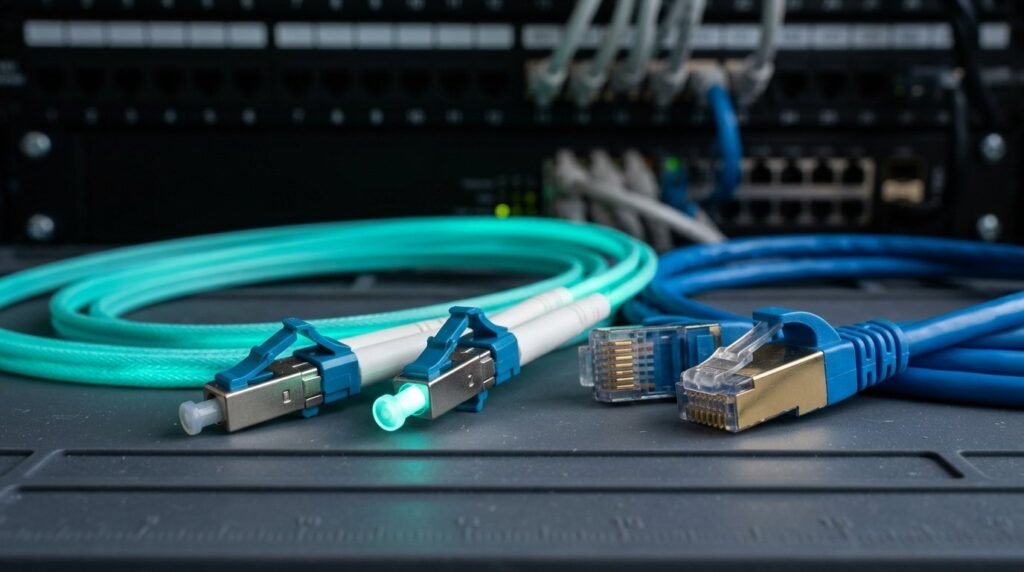
Light vs Electricity: Demystifying Physical Transmission Media
Modern enterprise networks rely on a harmonious combination of copper twisted-pair cables and optical fibre links. However, determining which medium should be installed in specific areas of a hotel, resort campus, or event venue requires an understanding of their fundamental physical principles.
While copper transmits data via electrical impulses over metallic conductors, fibre optics utilizes microscopic strands of pure glass to transmit data pulses as light. This fundamental difference governs their performance regarding distance, bandwidth, and environmental immunity.
The 100-Meter Copper Boundary
Standard Ethernet over copper (Cat5e, Cat6, Cat6A) has a hard physical ceiling of 100 meters (90m horizontal solid core + 10m total stranded patch leads). Any link extending beyond 100 meters must be engineered using optical fibre or specialized active repeaters.
Direct Comparison Matrix
| Attribute | Copper (Twisted Pair) | Fibre Optics |
|---|---|---|
| Maximum Reach | 100 meters (Channel) | Up to 550m (Multimode) / 40km (Singlemode) |
| Immunity to EMI | Susceptible to motors, lifts, fluorescent lights | 100% immune (dielectric glass medium) |
| Power Delivery | Carries PoE (up to 90W) | Cannot carry electrical current |
| Termination Cost | Fast, standard RJ45 punch-down | Requires precision fusion splicing equipment |
Where Each Belongs in Your Venue
- Use Fibre Optics For: Inter-building links across estate grounds, vertical riser backbones connecting floor distribution racks to the main comms room, and connections running through lift shafts or plant rooms with heavy electrical machinery.
- Use Copper For: Horizontal distribution from floor switches to guest room TV drops, access points, telephony handsets, and CCTV cameras requiring Power over Ethernet.