
The Ultimate Guide to Pub WiFi: Everything Pub Owners Need to Know
Why Pub WiFi Matters More Than Ever

A decade ago, pub WiFi was considered a nice extra. Today, it’s an essential part of the customer experience.
Whether guests are checking emails over a coffee, posting photos of their lunch on Instagram, watching live sports highlights, using mobile payment apps or working remotely for a few hours, reliable connectivity has become an expectation.
For pub owners, WiFi is no longer simply about internet access. It directly impacts customer satisfaction, online reviews, operational efficiency and revenue generation.
The challenge is that many venues still rely on networking equipment designed for homes rather than busy hospitality environments. A single all-in-one router that works perfectly in a three-bedroom house is unlikely to deliver the performance required in a venue serving hundreds of customers.
Modern pub WiFi needs to support guests, staff, payment systems, security systems and business applications simultaneously. When designed correctly, it becomes a valuable business asset. When designed poorly, it becomes a constant source of complaints and operational issues.
What Today’s Customers Expect
Customer expectations have changed dramatically.
Guests expect:
- Fast internet access
- Reliable coverage throughout the venue
- Seamless connectivity
- Simple onboarding
- Outdoor connectivity
- Secure access
Importantly, guests rarely distinguish between internet speed and WiFi quality.
A pub may have a 1Gbps fibre connection, but if the WiFi design is poor, customers will still complain.
What customers actually experience is:
- Coverage
- Stability
- Reliability
- Ease of connection
A customer sitting in a beer garden with poor signal strength will not care how fast the broadband connection is if their device keeps disconnecting.

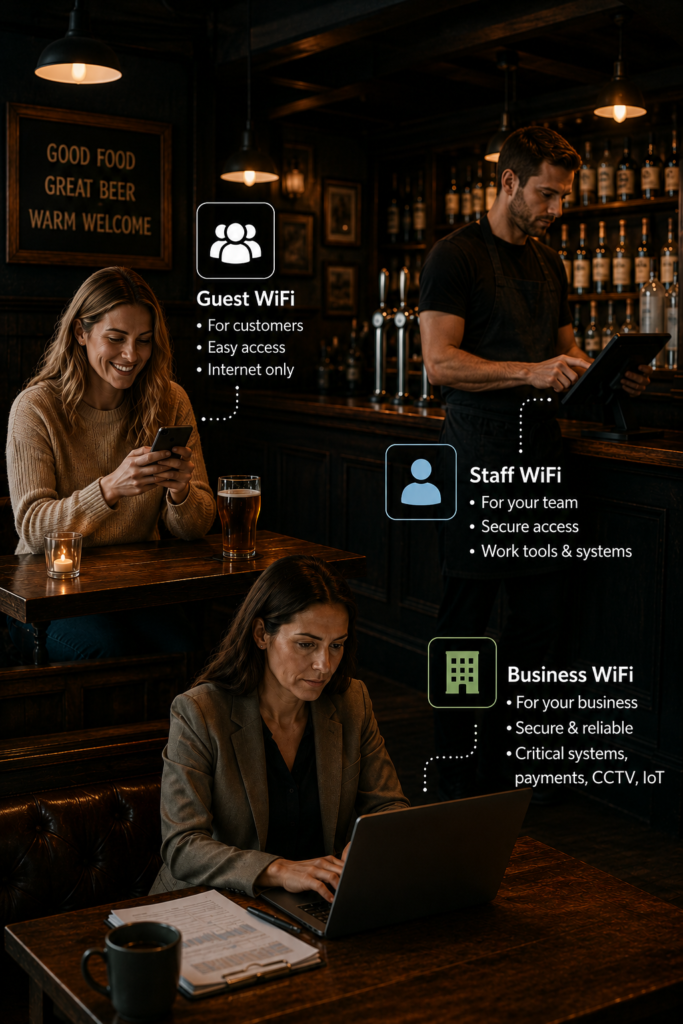
Guest WiFi, Staff WiFi and Business WiFi Are Not the Same Thing
One of the biggest mistakes pubs make is running everything on a single network.
A modern hospitality network should consist of multiple segregated environments.
Guest WiFi
Guest WiFi should provide:
- Secure internet access
- Easy onboarding
- Traffic management
- Usage analytics
- Marketing opportunities
Guests should never have visibility of business systems.
Staff WiFi
Staff networks support:
- Tablets
- Mobile ordering devices
- Stock management systems
- Management applications
- Internal communications
These devices require higher priority than guest traffic.
Business and Operational Networks
Critical systems include:
- POS systems
- Card payment terminals
- CCTV systems
- Digital signage
- Smart building controls
- Music systems
- IPTV services
These systems should operate on separate secured networks to ensure reliability and security.
How Much Bandwidth Does a Pub Actually Need?
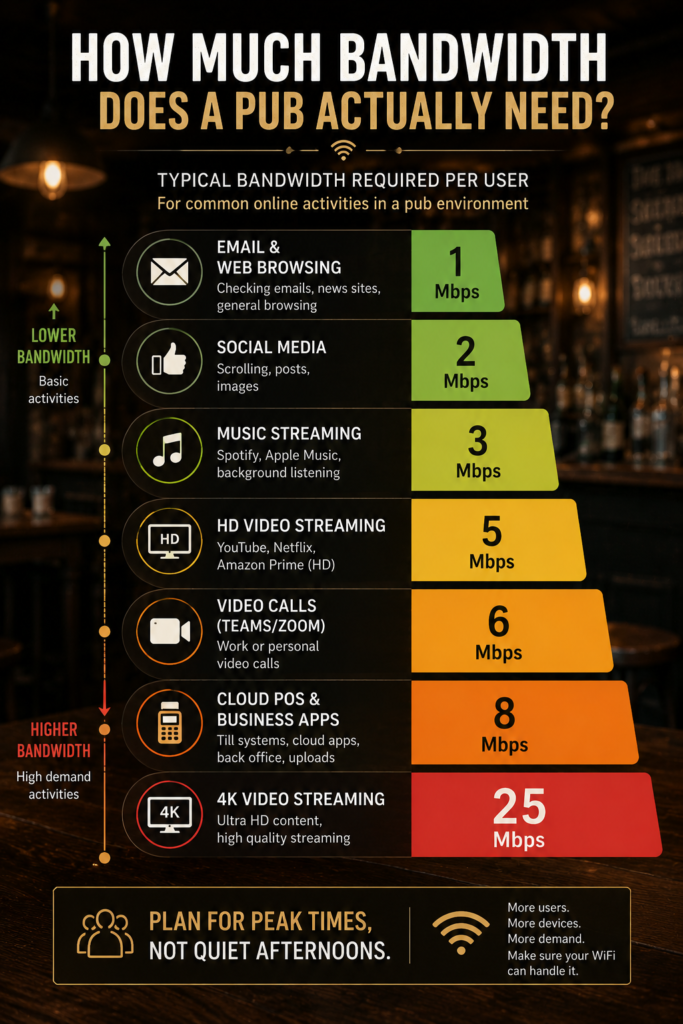
Many providers sell speed without understanding how venues operate.
The answer depends on customer behaviour.
A small community pub may require only 100-200Mbps.
A busy sports pub showing Premier League football could require significantly more.
Typical usage includes:
- Streaming video
- Social media
- Video calls
- Remote working
- Cloud applications
- Mobile payments
The key consideration is not simply broadband speed but ensuring the entire network is designed to support peak occupancy.
A venue serving 250 customers on match day creates a very different networking challenge compared to a quiet weekday lunch service.
Why Home Routers Are Not Suitable for Pubs
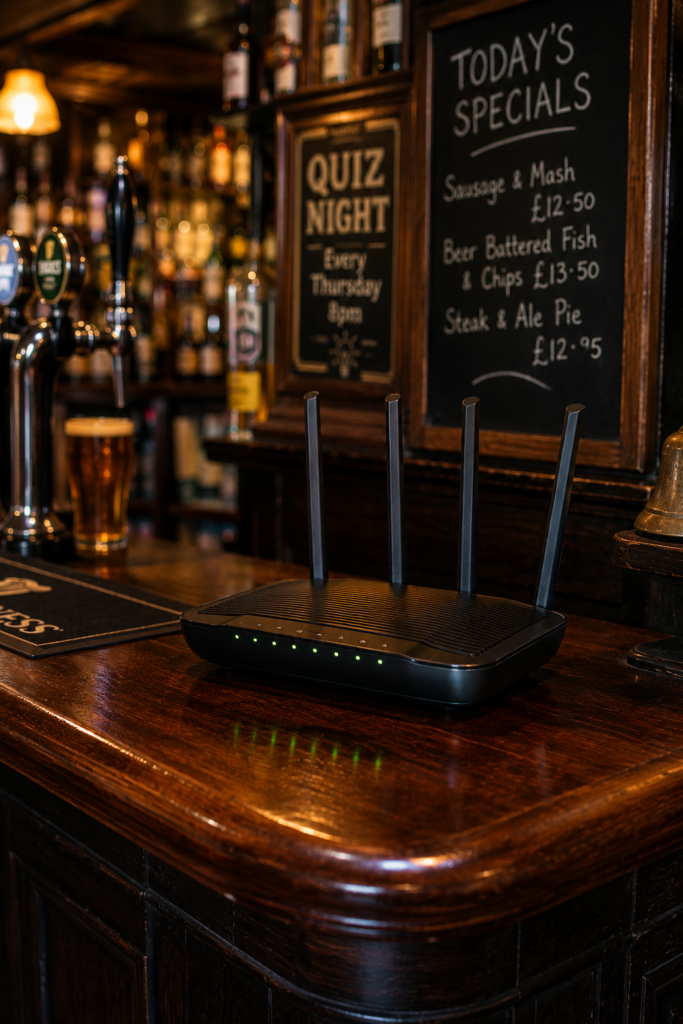
Many venues begin with the same equipment they use at home.
Unfortunately, hospitality environments present very different challenges.
A domestic router is designed to support:
- Limited users
- Small spaces
- Predictable usage
A pub network must support:
- Hundreds of simultaneous devices
- Multiple services
- Indoor and outdoor coverage
- High-density environments
- Business-critical applications
Professional WiFi systems use multiple access points positioned throughout the venue to create consistent coverage and capacity.
This ensures every customer receives a reliable experience regardless of where they sit.
Why Coverage Matters More Than Speed
Many broadband providers focus exclusively on speed.
Coverage is often the bigger issue.
A customer with excellent signal strength on a 100Mbps connection will usually enjoy a better experience than someone with poor signal strength on a 1Gbps connection.
Professional WiFi design focuses on:
- Coverage
- Capacity
- Signal quality
- Roaming performance
- Interference management
This is why professional surveys and heat mapping are essential.
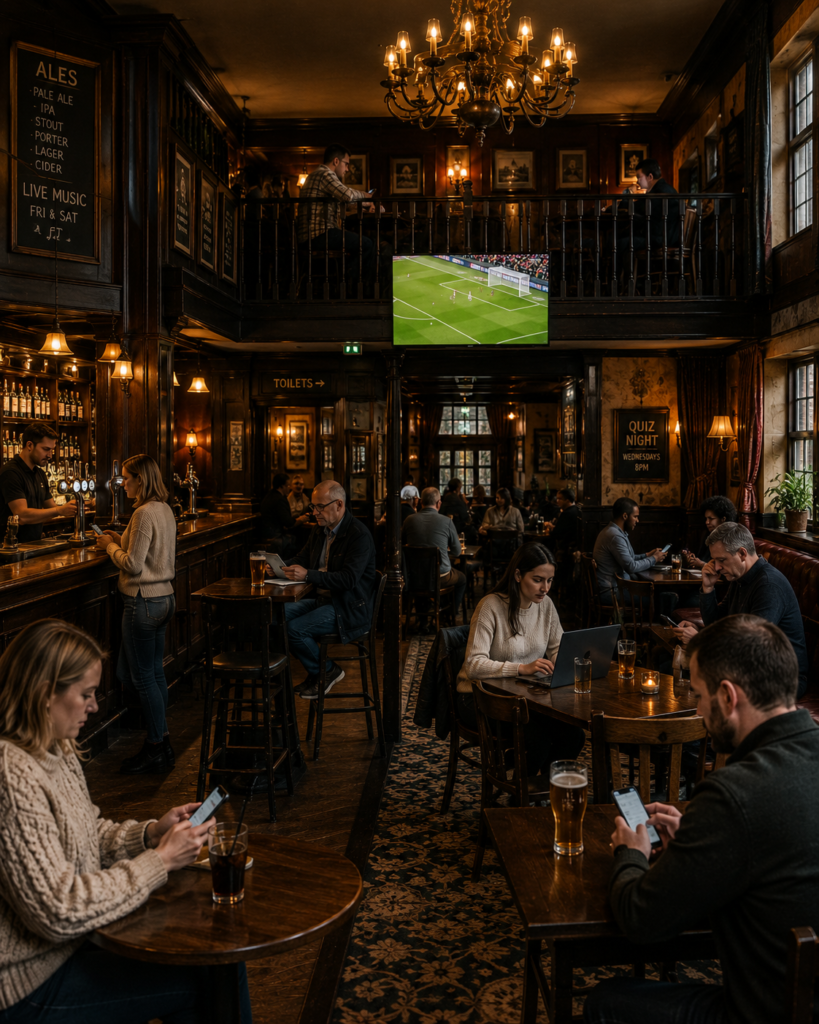
Why Every Pub Needs Outdoor WiFi
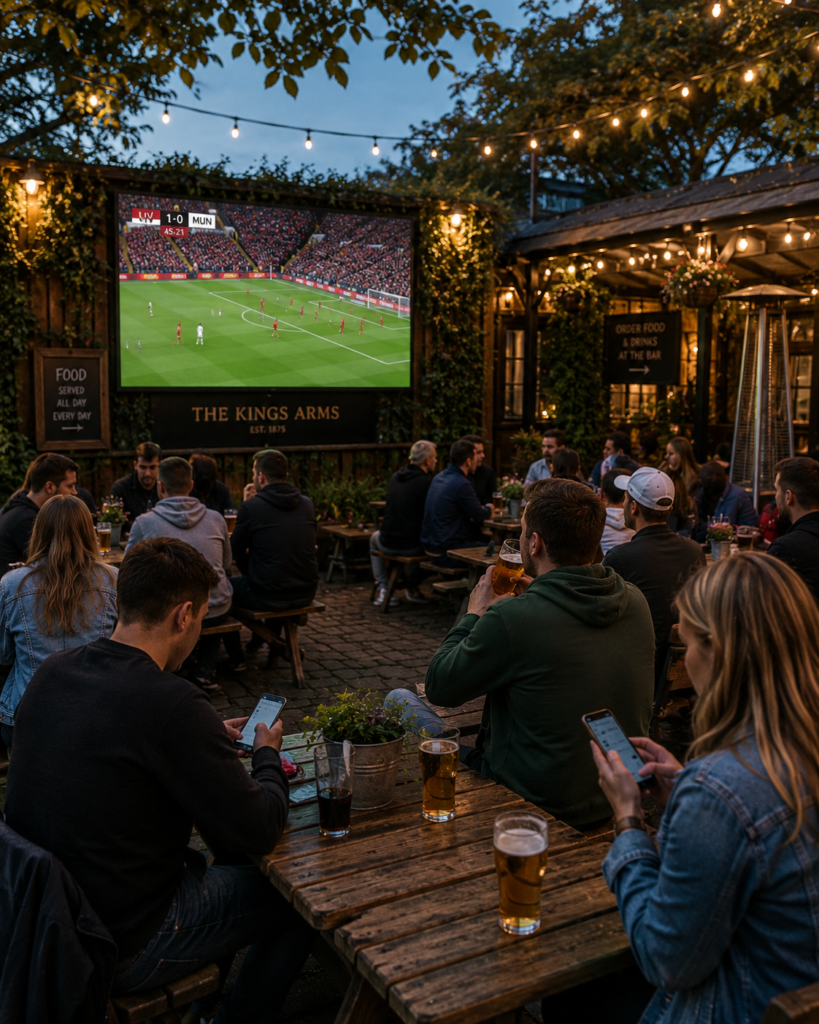
Beer gardens have become one of the most important areas of many venues.
Customers now expect connectivity in:
- Beer gardens
- Terraces
- Courtyards
- Outdoor dining areas
- Smoking areas
Outdoor coverage should never be treated as an afterthought.
Professional outdoor access points are specifically designed to withstand:
- Rain
- Dust
- Temperature fluctuations
- High user density
Providing outdoor coverage often increases dwell time and customer spend.
Operational benefits include:
- Fewer printed notices and lower manual update effort
- Faster communication across the property
- Reduced front desk questions about directions, events and opening times
- Improved consistency of brand and messaging
- Simpler management across multiple departments and locations
- Better support for temporary campaigns, seasonal offers and event changes
Why Mesh WiFi Is Usually the Wrong Answer
Mesh systems are heavily marketed as a simple solution.
While they have a place in residential environments, they are often unsuitable for hospitality deployments.
Mesh networks introduce:
- Additional wireless hops
- Reduced performance
- Increased latency
- Greater complexity
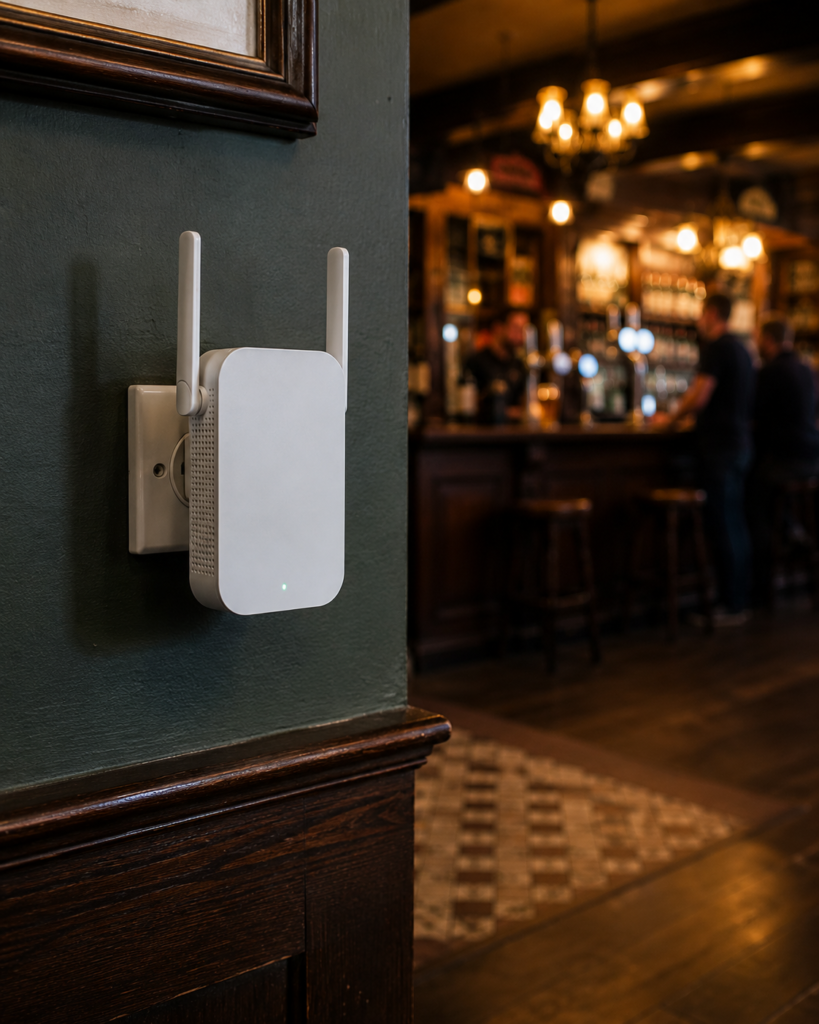
Whenever possible, access points should be connected using structured cabling.
A properly cabled WiFi network delivers:
- Better performance
- Greater reliability
- Easier troubleshooting
- Longer-term scalability
Structured Cabling: The Foundation of Great WiFi
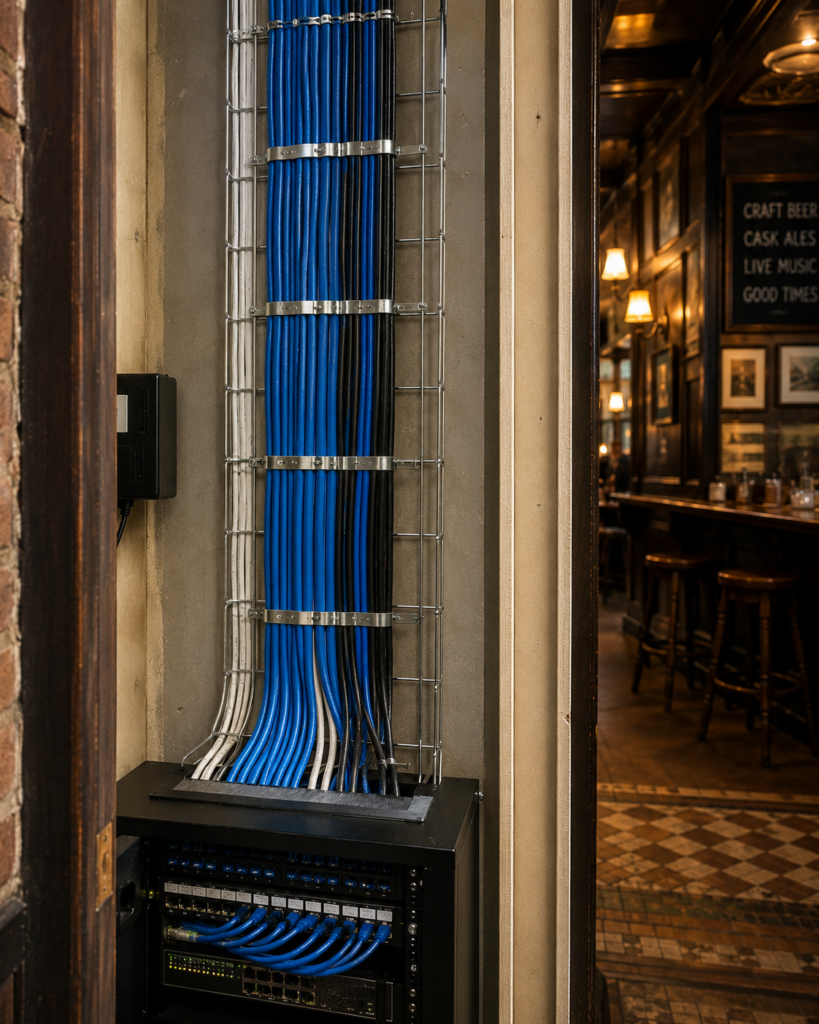
WiFi may be wireless, but successful WiFi deployments rely heavily on cabling.
Every access point requires a high-quality wired connection back to the network.
Professional structured cabling provides:
- Reliable connectivity
- Future scalability
- Easier maintenance
- Support for PoE devices
Poor cabling often causes more network problems than the WiFi equipment itself.
Racks, Cabinets and Physical Security
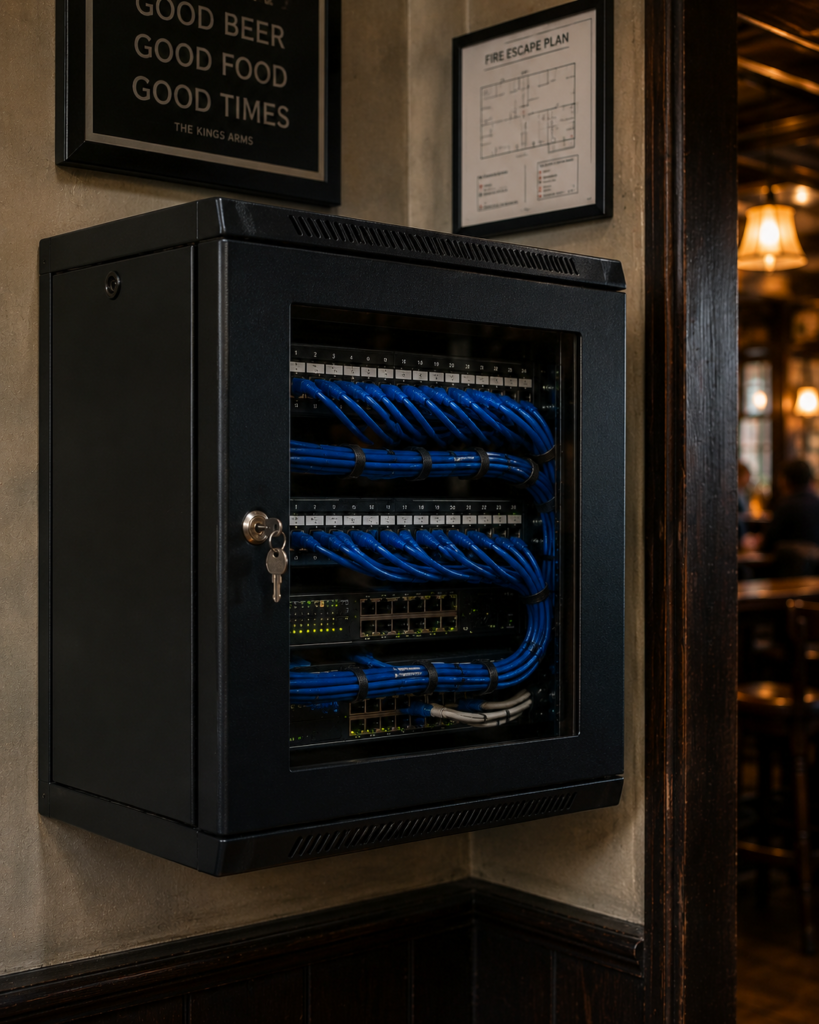
Network infrastructure should be protected.
A professional installation includes:
- Secure communications cabinets
- Patch panels
- Managed switches
- UPS systems
- Proper cable management
This not only improves reliability but also simplifies maintenance and future upgrades.
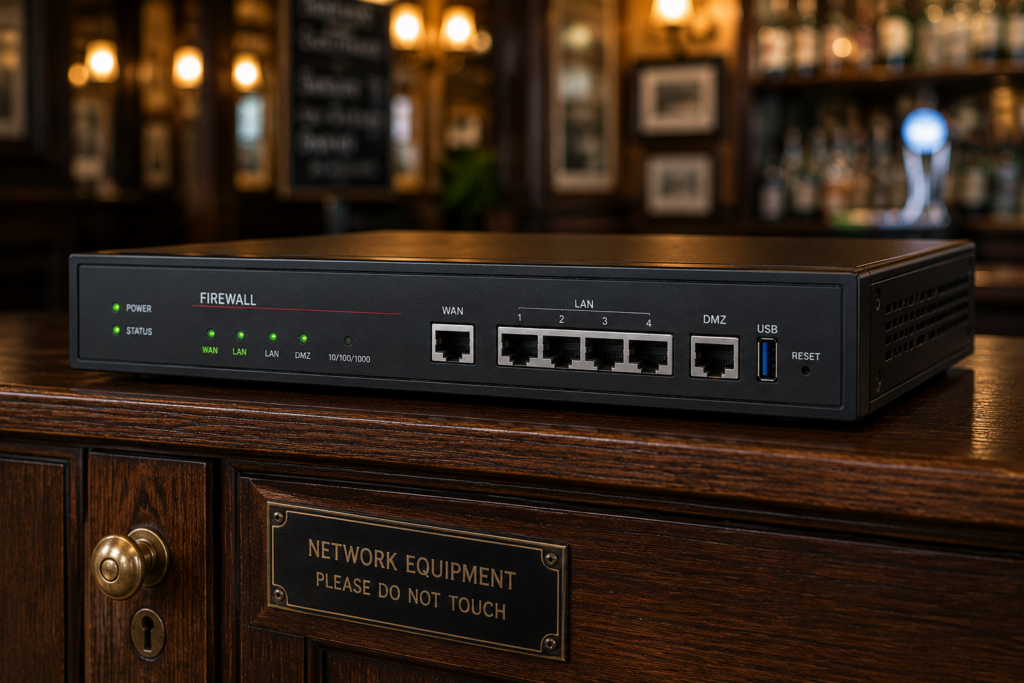
Firewalls and Network Security
Cybersecurity is increasingly important in hospitality environments.
Modern pub networks support:
- Customer data
- Payment systems
- CCTV
- Business applications
Professional firewalls provide:
- Threat protection
- Content filtering
- Intrusion prevention
- VPN connectivity
- Traffic segmentation
Security should be considered from the beginning rather than added later.
PCI Compliance and Payment Security
Card payments are the lifeblood of most pubs.
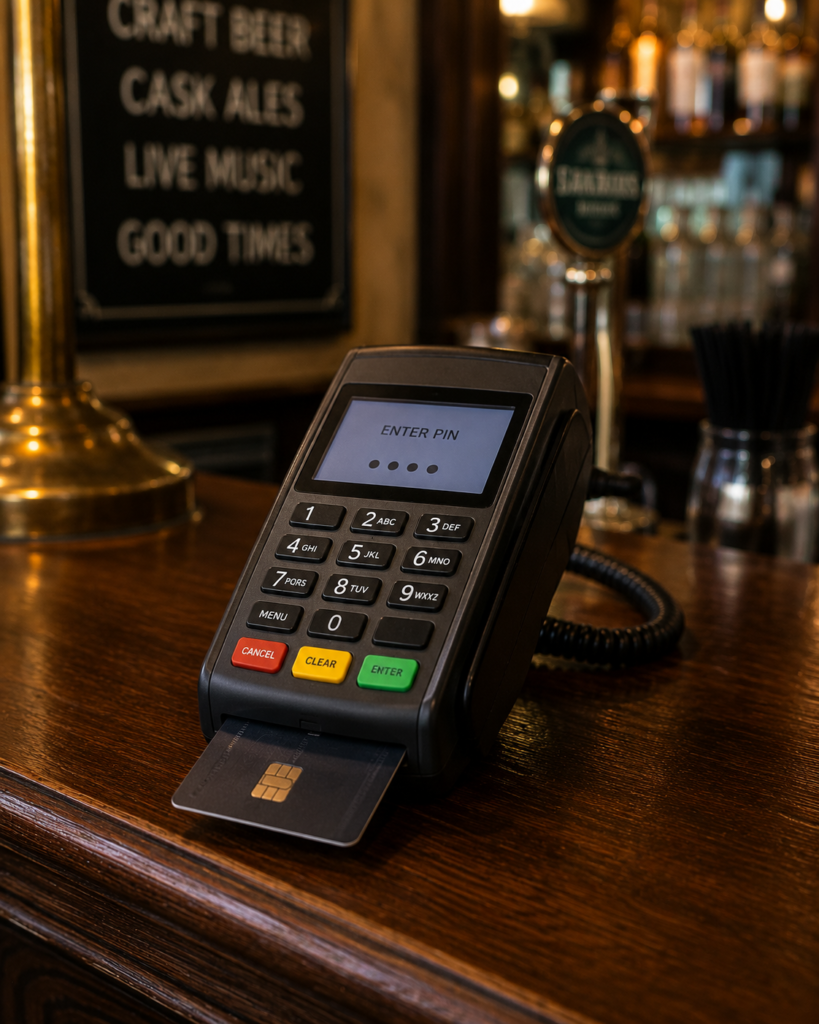
Guest WiFi should never share the same network as payment systems.
Proper segmentation ensures:
- Guest traffic remains isolated
- Payment systems remain protected
- Compliance requirements are supported
- Operational reliability is maintained
This is one of the most important design considerations in any hospitality environment.
WiFi as a Marketing and Revenue Tool
Guest WiFi can deliver much more than internet access.
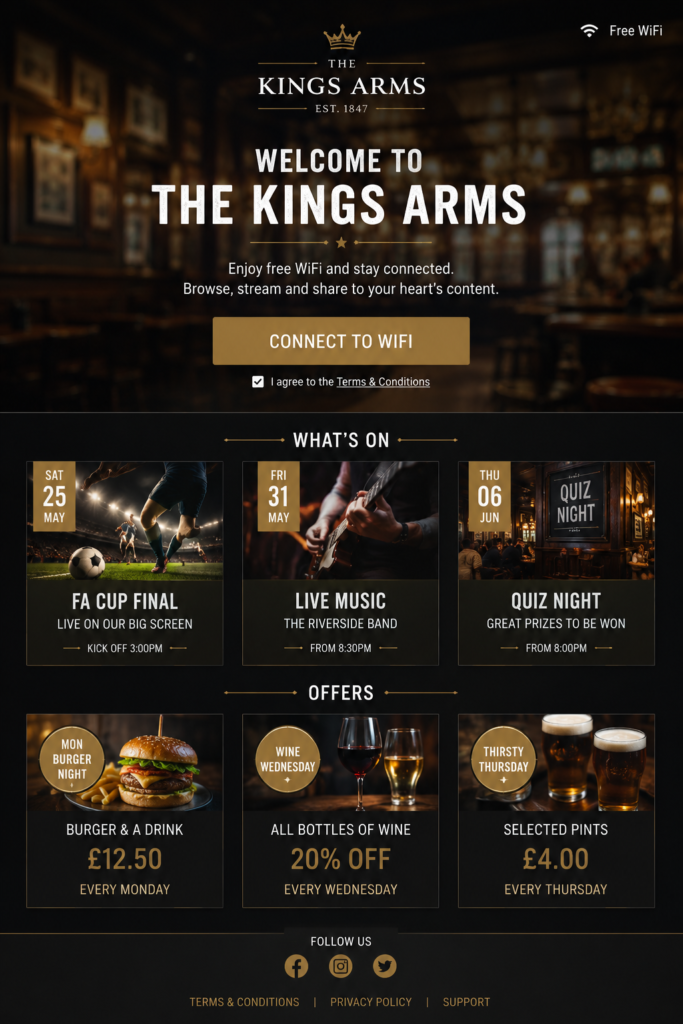
Modern captive portals can:
- Promote events
- Advertise food offers
- Promote accommodation
- Highlight live music
- Drive loyalty programme sign-ups
The login process becomes a marketing opportunity rather than simply a technical requirement.
Many venues overlook the commercial value of their WiFi platform.
Captive portals can be used to:
- Promote local businesses
- Sell advertising placements
- Promote partner events
- Drive cross-selling opportunities
This transforms WiFi from a cost centre into a revenue-generating asset.
Multi-Site Pub Groups and Customer Recognition
For pub groups, guest WiFi becomes even more powerful.
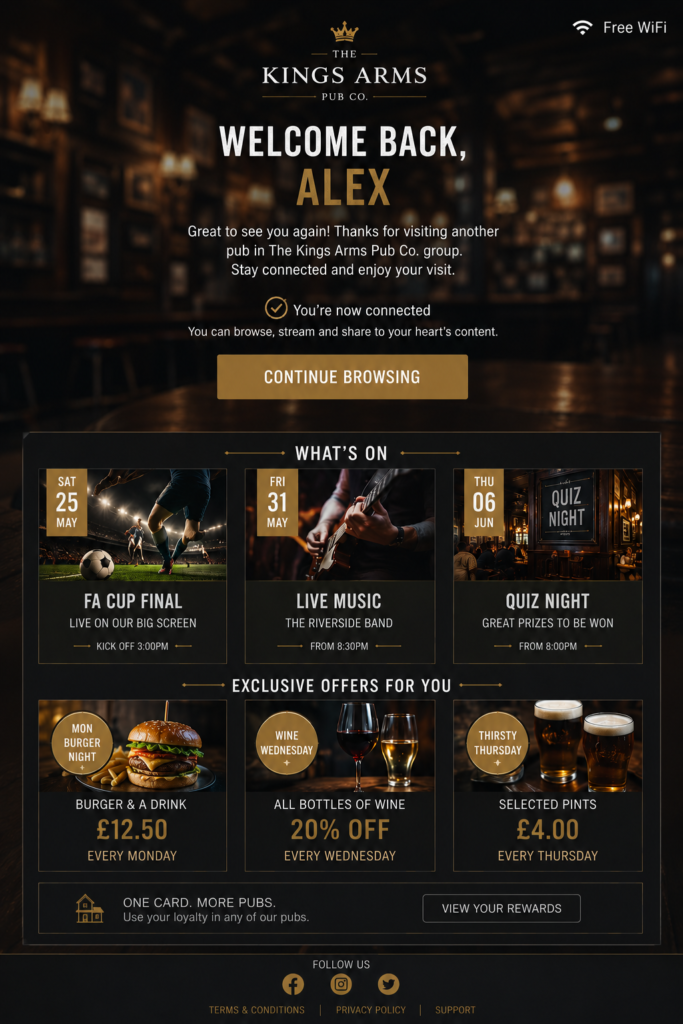
Modern platforms can recognise returning visitors across multiple venues.
A customer visiting one pub can be recognised when they visit another location within the same group.
Benefits include:
- Consistent branding
- Improved customer experience
- Reduced login friction
- Better marketing opportunities
- Improved customer insight
This creates a seamless digital experience across an entire estate.
Connectivity Resilience and Business Continuity
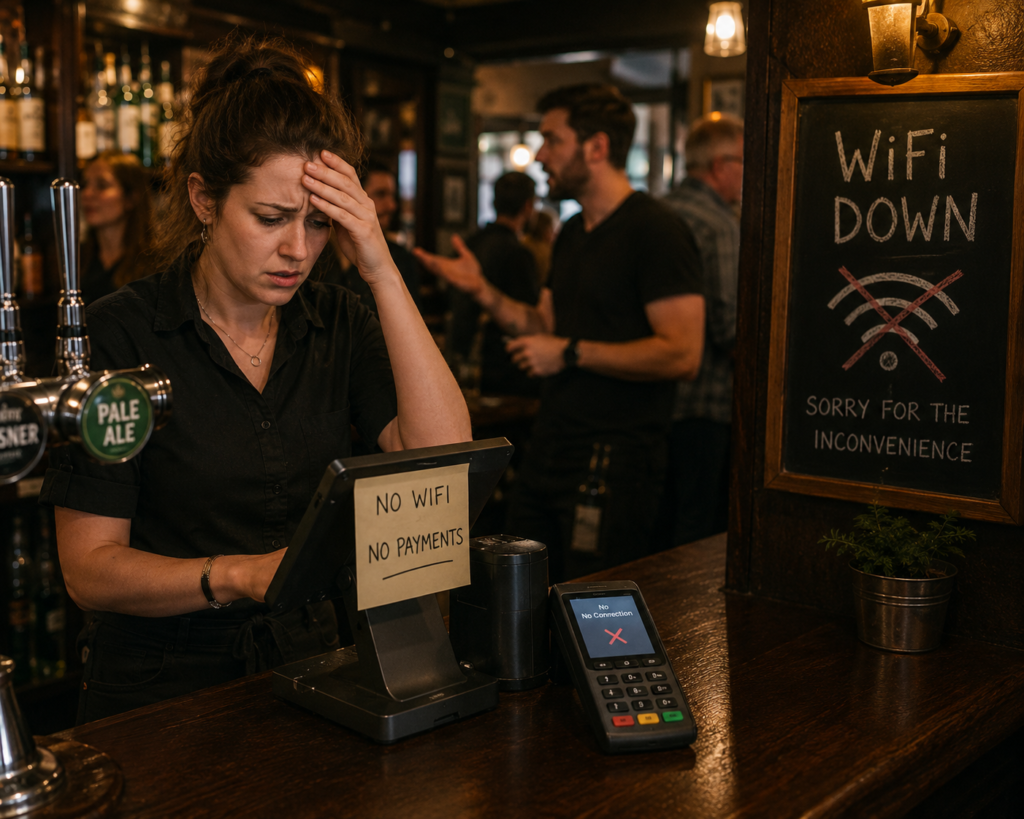
What happens if your broadband connection fails?
Can you still:
- Process card payments?
- Take orders?
- Run tills?
- Access cloud applications?
Professional networks should include resilience measures such as:
- Secondary internet connections
- Automatic failover
- 4G/5G backup connectivity
Business continuity planning is no longer optional.
Analytics and Customer Insights
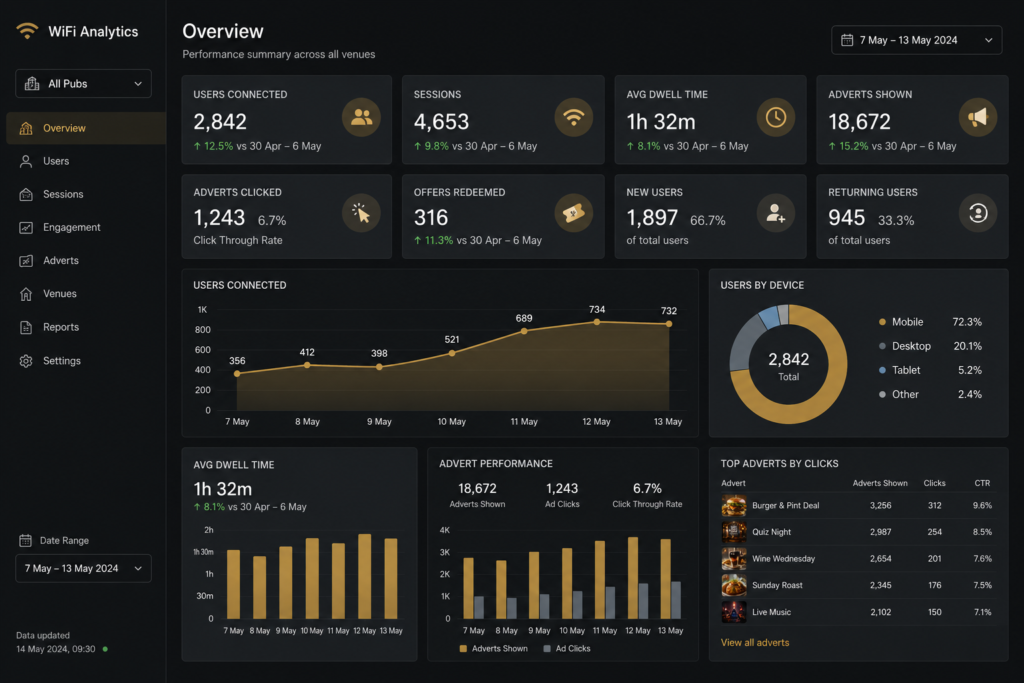
Modern WiFi platforms provide valuable business intelligence.
Operators can gain visibility into:
- Footfall
- Repeat visitors
- Peak occupancy periods
- Customer dwell time
- Visitor frequency
These insights can support better operational and marketing decisions.
Smart Pub Technology
Today’s network often supports much more than WiFi.
Connected infrastructure can support:
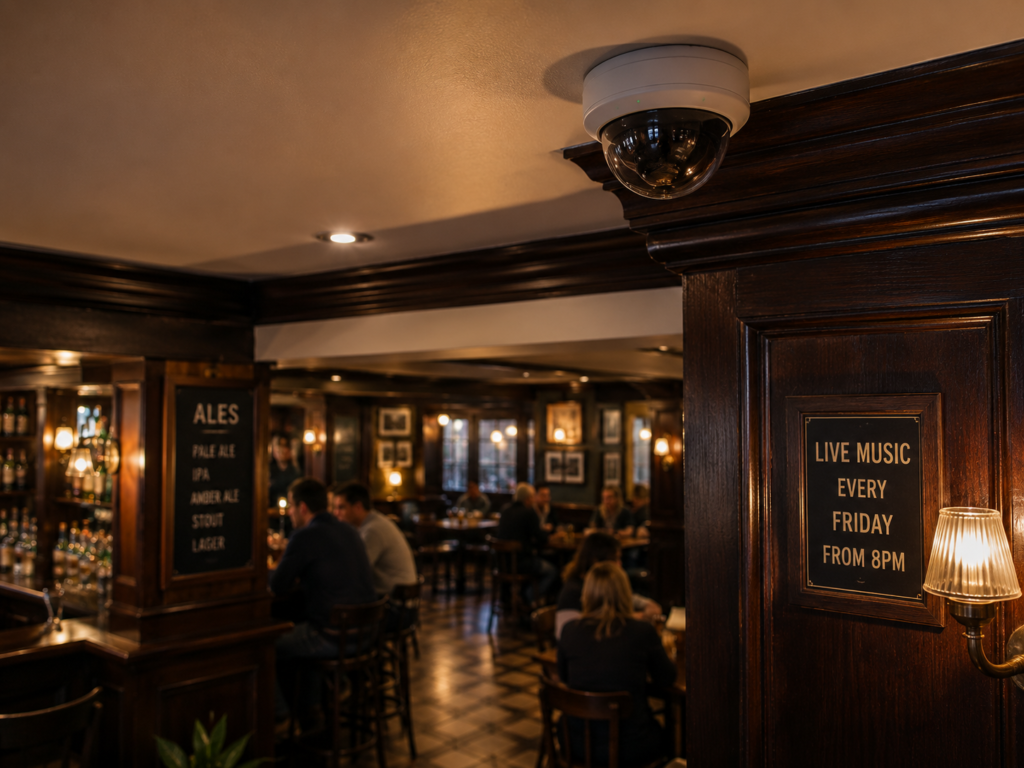
- CCTV
- Digital signage
- IPTV systems
- Environmental sensors
- Smart heating controls
- Occupancy monitoring
A professionally designed network becomes the foundation for future innovation.
Why Installation Alone Is Not Enough
Many providers focus solely on selling and installing access points.
That is only the beginning.
Ongoing success requires:
- Monitoring
- Performance optimisation
- Firmware management
- Security updates
- Capacity planning
- Support services
The best hospitality WiFi providers do not simply install networks. They manage connectivity as an ongoing service.
When evaluating suppliers, ask:
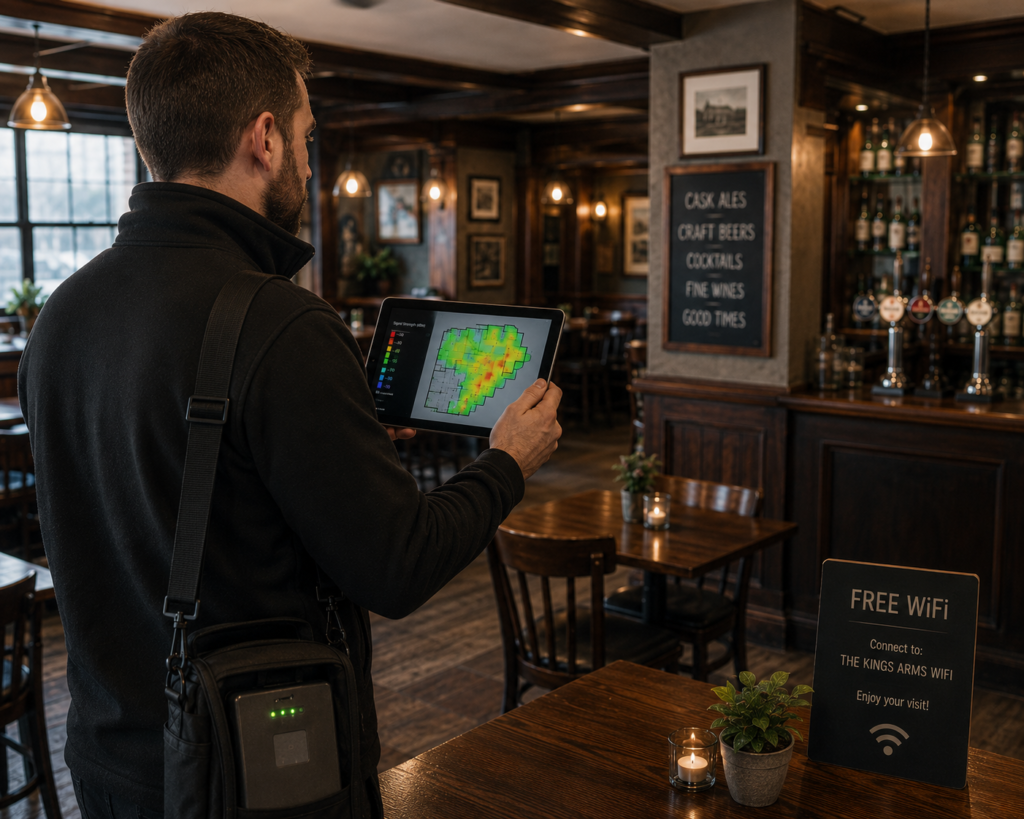
- Do they conduct WiFi surveys?
- Do they provide heat maps?
- Can they support guest onboarding?
- Do they understand hospitality operations?
- Can they integrate multiple systems?
- Do they provide ongoing monitoring?
- Can they support multi-site environments?
The cheapest quote is rarely the most cost-effective solution.
Final Thoughts
Pub WiFi is no longer just about providing internet access.
It influences customer satisfaction, staff productivity, payment security, operational efficiency and revenue generation.
The most successful venues treat connectivity as a strategic business asset rather than a utility.
By investing in professional design, secure infrastructure, proper segmentation and ongoing support, pub operators can create an experience that customers expect, staff rely on and the business can grow around.
At Connected Hospitality, we help hospitality businesses design, deploy and manage WiFi networks that do far more than simply get people online. We create connected environments that support better experiences, better operations and better commercial outcomes.