
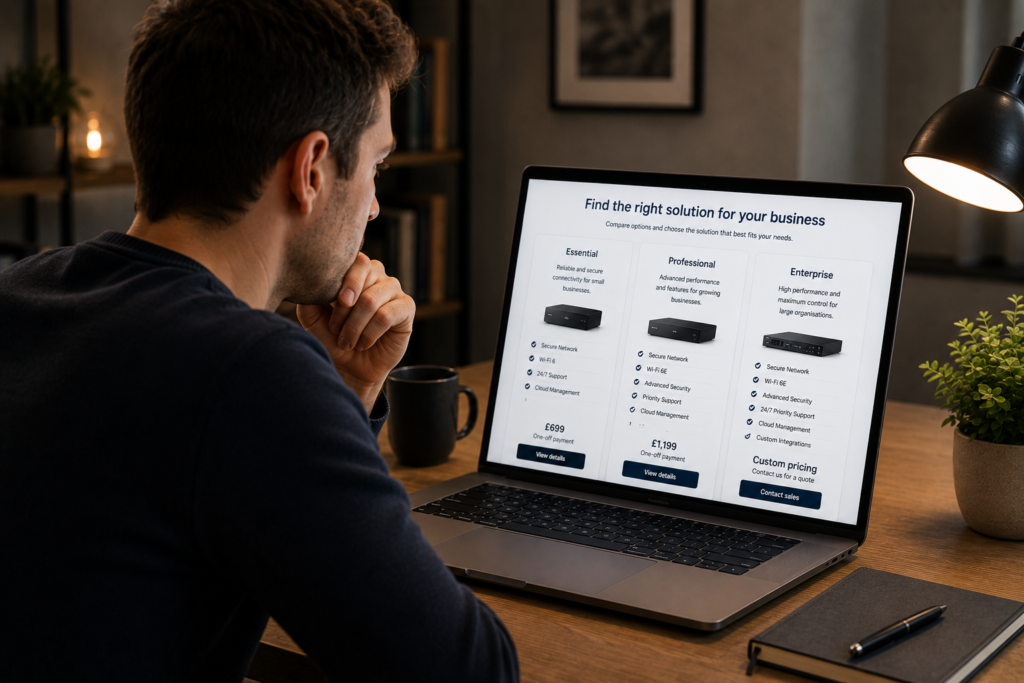
A hotel replaces every access point, adopts the latest Wi-Fi standard and expects complaints to disappear. The new equipment goes live, yet guests still report buffering, dropped calls, weak coverage and unreliable roaming. The specification has improved; the experience has not.
This happens because an access point is only one part of a working wireless service. Its performance depends on where it is installed, how the radio environment has been designed, the condition of the cabling and switches behind it, the internet connection, network services and the devices guests and staff are actually using.
A successful Wi-Fi upgrade therefore starts with the problem and the required outcome—not the product catalogue. New hardware can create major benefits, but only when the wider network is ready to support it and the finished deployment is tested against real operational requirements.
An upgrade is not the same as a replacement
Replacing old equipment may be necessary because it is unsupported, insecure or no longer capable of handling demand. However, exchanging one access point for another in the same position is a hardware refresh. It becomes a genuine Wi-Fi upgrade only when it delivers a measurable improvement for users and the operation.
Before buying anything, establish a baseline. Where do connections fail? Which areas struggle at peak occupancy? Are problems limited to particular devices or applications? Do faults occur during roaming, authentication or internet access? What performance do operational systems such as staff handsets, mobile ordering and building devices require?
Without that evidence, a project can be declared complete because the new access points are online—even though nobody has proved that the original problem was solved.
The access point is only one layer
RF design, placement and capacity
Hospitality buildings are difficult radio environments. Bedrooms, corridors, lifts, kitchens, plant, thick walls, mirrors, meeting rooms and large open spaces all affect signal differently. Coverage also does not equal capacity: a ballroom may show a strong signal when empty and perform badly once hundreds of active devices compete for airtime.
Access-point location, mounting height, antenna pattern, channel width, transmit power and neighbouring networks all influence the outcome. Adding more radios without controlling overlap can make interference worse. HPE Aruba’s RF design guidance is clear that stable WLAN performance depends on planning, accurate installation and appropriate configuration—and that wireless networks should be designed for device capacity, not coverage alone.
The wired network and services behind it
Every access point still relies on structured cabling, a switch port, sufficient Power over Ethernet and an uplink with enough capacity. Older cabling may negotiate at a lower speed or be unreliable; legacy switches may not provide the power or multi-gigabit connectivity required by newer equipment. A modern radio connected to a constrained wired network cannot deliver its full capability.
The apparent Wi-Fi fault may also sit elsewhere. Slow DHCP responses, DNS failures, authentication delays, captive-portal problems, firewall policies, internet congestion or a failed circuit can all create a poor wireless experience while the RF itself is healthy. That is why Connected Hospitality treats Wi-Fi, networks and connectivity as one service rather than isolated components.
Why lift-and-shift projects disappoint
A lift-and-shift refresh removes the old access points, installs new ones in the same locations and carries forward much of the existing design. It reduces disruption and may be appropriate where the original design has been validated. The mistake is assuming that every inherited decision remains correct.
The previous positions may have been chosen around available cable routes rather than user experience. The building layout and occupancy may have changed. Old channel, power and minimum data-rate settings may be copied into a new platform. Additional radios and wider channels may then increase contention rather than improve performance.
Reuse should be evidence-led. Existing cabling and positions can save money when they meet the new design; they should not become fixed constraints simply because changing them is less convenient.
What newer Wi-Fi can genuinely improve
The advances in Wi-Fi 6, Wi-Fi 6E and Wi-Fi 7 are real. They can improve efficiency, capacity and latency, while 6 GHz offers additional spectrum that can relieve congestion in suitable environments. Wi-Fi 7 also introduces capabilities such as Multi-Link Operation and wider channels for compatible clients.
Those benefits are conditional. The client device must support the relevant feature; signal quality must be sufficient; channel planning must suit the environment; and the cabling, switching, PoE and uplinks must support the selected access points. Six-gigahertz coverage, security requirements and client adoption also need to be designed and validated rather than assumed.
This does not mean every project needs more access points or that a one-for-one replacement can never work. It means the decision should follow a survey and capacity assessment. For a practical comparison of the generations, read Wi-Fi 6 vs Wi-Fi 7 in hospitality networks.
What a real Wi-Fi upgrade should include
- Define the required outcome. Identify the users, applications, critical systems, busy periods, coverage areas and service levels that matter. “Install the latest access points” is not an outcome.
- Measure the existing network. Review monitoring data, support tickets and user complaints. Test connection success, roaming, latency, packet loss, throughput and utilisation in the places and periods where problems occur.
- Survey and redesign where necessary. Use predictive design and, where appropriate, an onsite survey to understand attenuation, interference, mounting restrictions and capacity. The design should include client types and peak density—not just floor area.
- Check infrastructure readiness. Validate cabling, switch capacity, PoE budgets, uplinks, internet circuits, resilience, firewalls and core network services before finalising the equipment choice.
- Implement in a controlled way. Agree change windows, configuration standards, migration stages and rollback plans. Test a representative area first where the estate or risk justifies it.
- Validate the finished service. Survey after installation and test with representative guest, staff and operational devices. Compare the results with the original baseline and agreed acceptance criteria.
- Monitor and optimise. Occupancy, interference, devices and applications change. Ongoing visibility allows configuration to be tuned and developing faults to be addressed before they become recurring complaints.
Rich’s Engineering Take
The wrong first question is, “Which access points should we buy?” The right first question is, “What is failing, where is it failing and what evidence proves the cause?”
A survey might confirm that replacement hardware and additional capacity are needed. It might also uncover bad cabling, poor mounting, interference, an overloaded switch, a slow guest portal or an internet-resilience problem. Each requires a different fix.
Diagnose first, design for the way the venue actually operates, and agree how success will be measured. That is how a Wi-Fi budget becomes an operational improvement instead of a more expensive version of the same complaint.
Measure the experience—not the specification sheet
Users do not judge a network by its theoretical PHY rate. They judge whether they can connect first time, move around without interruption, make a call, stream content and use the services they need. The hospitality operation cares whether mobile ordering, staff communications and connected devices remain dependable when the venue is busy.
Useful success measures can include connection and authentication rates, complaint and support-ticket volumes, roaming stability, latency, packet loss, application performance and peak-time utilisation. Internet performance should be measured separately from local wireless performance so that the cause of any constraint remains visible.
Before approving a proposal, ask what evidence determined access-point numbers and locations, what existing infrastructure will be reused, how peak demand has been modelled, which devices will be tested, how resilience will work and what the acceptance criteria are. A credible design should explain both the equipment and the engineering decisions behind it.
Frequently asked questions
Will faster access points make the internet faster?
Only if the wireless network is the constraint. New access points cannot increase the speed of the internet circuit or correct congestion, packet loss, DNS issues or a failing firewall. The complete path must be measured.
Can existing access-point locations and cabling be reused?
Often they can, but only after validation. Locations must suit the new RF design, while cabling, switches, PoE capacity and uplinks must support the selected equipment. Reuse is valuable when it is a design decision rather than an assumption.
Does Wi-Fi 7 automatically improve coverage?
No. Coverage still depends on frequency, building materials, antenna behaviour, placement, power and the client device. Wi-Fi 7 can deliver important performance benefits, but it does not remove the need for RF design.
Is a wireless survey necessary for every upgrade?
The level of survey should be proportionate to the building, risk and required outcome. At minimum, the existing service and planned design need evidence-based validation. Complex, high-density or business-critical environments will normally justify more detailed onsite measurement and post-installation testing.
Improve the outcome—not just the hardware
Connected Hospitality designs, surveys, deploys and supports wired and wireless networks around the realities of hotels, venues and other demanding hospitality environments. The objective is not to replace equipment unnecessarily; it is to find the constraint and create a service that works reliably for guests, staff and operational systems.
If your current Wi-Fi upgrade proposal begins and ends with a list of access points, speak to Connected Hospitality about an evidence-led review before the investment is committed.