
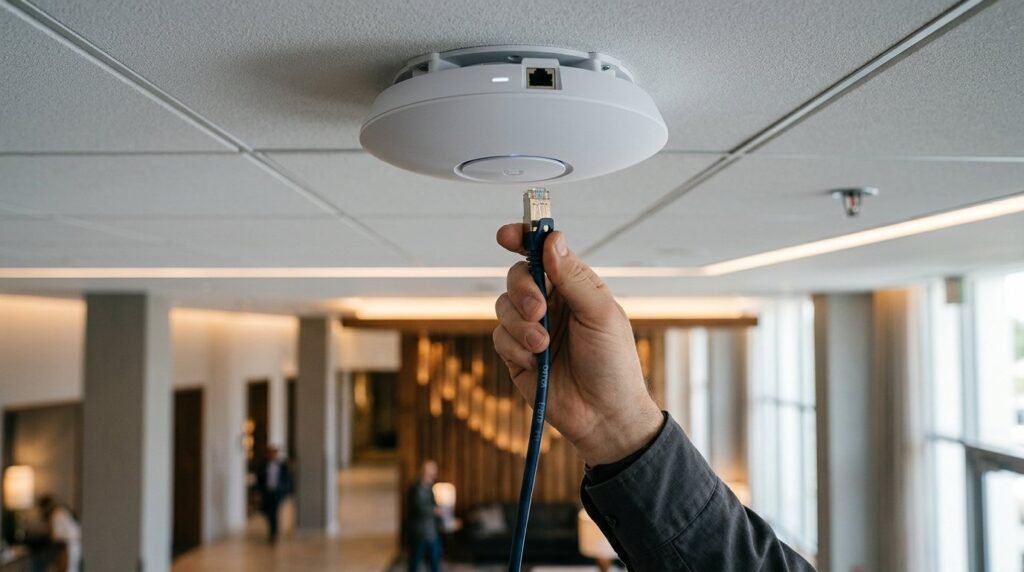
Simplifying Infrastructure with Power over Ethernet (PoE)
Modern hospitality venues rely on an ever-expanding array of connected devices: high-performance Wi-Fi access points, IP surveillance cameras, digital signage panels, VoIP handsets, and smart room environmental sensors. Traditionally, deploying each device required two separate trades: an electrician to install a local mains power socket and a network technician to pull a data cable.
Power over Ethernet (PoE) revolutionizes deployment by transmitting electrical power alongside high-speed data across a single standard twisted-pair Ethernet cable (Cat6 or Cat6A). This substantially cuts installation costs, minimizes visual clutter, and centralizes electrical backup protection.
Centralized Resilience Advantage
Because all PoE devices receive power directly from the comms room switch, placing a single Uninterruptible Power Supply (UPS) in the comms rack keeps your entire Wi-Fi network, security cameras, and phone system operational during mains power fluctuations.
Understanding the PoE Standards
| Standard | Industry Name | Max Power per Port | Typical Hospitality Use |
|---|---|---|---|
| IEEE 802.3af | PoE (Type 1) | 15.4W | Basic VoIP handsets, static indoor CCTV |
| IEEE 802.3at | PoE+ (Type 2) | 30W | Dual-radio Wi-Fi 6 APs, PTZ cameras |
| IEEE 802.3bt | PoE++ (Type 3/4) | 60W – 90W | Tri-band Wi-Fi 7 APs, interactive kiosks, digital signage |
Key Planning Considerations for Hotel Installations
- Total Switch Power Budget: A 24-port PoE+ switch may not be able to deliver 30W on all 24 ports simultaneously. Always verify that the switch’s total power supply rating matches your device load requirements.
- Heat Dissipation in Cable Bundles: When carrying 60W+ over high-density bundles of 48+ cables, heat accumulates inside conduit. Specifying Cat6A with pure solid copper conductors (never Copper Clad Aluminium / CCA) prevents resistive heat degradation.
- Remote Power Cycling: Managed PoE switches allow engineers to remotely reboot unresponsive access points or security cameras from a central dashboard with a single click, eliminating on-site maintenance callouts.