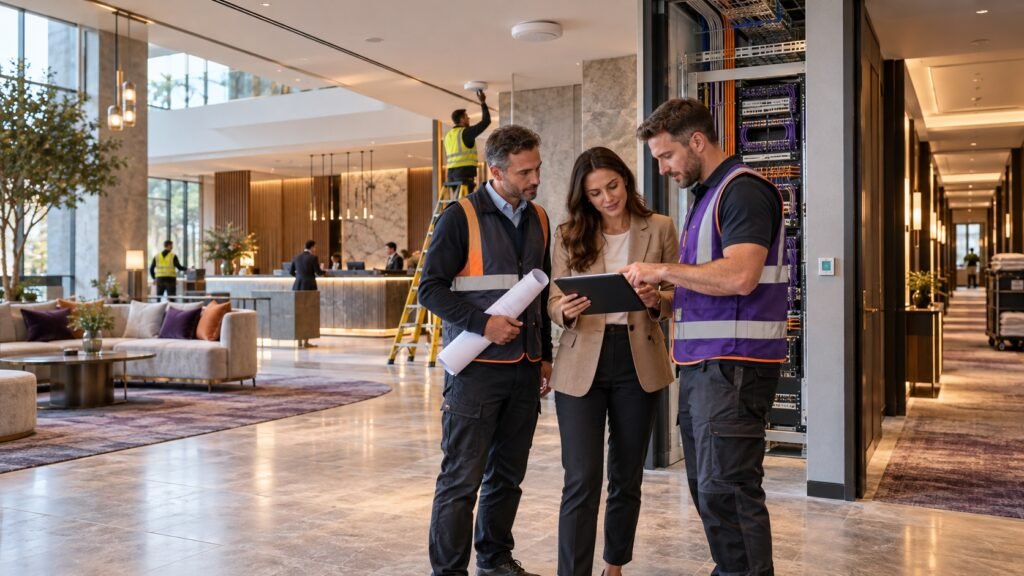
Technology in a new-build hotel cannot be left until the property is nearly ready to open. The decisions that determine whether the network, Wi-Fi, televisions, telephony, payments, CCTV and operational systems will work are made much earlier—when the project team agrees room layouts, risers, cable routes, comms rooms, power, ceilings and supplier responsibilities.
Once walls are closed, finishes are installed and guestrooms are being handed over, correcting a missing cable, undersized cabinet or poorly positioned access point becomes slower, more disruptive and more expensive. The equipment may be modern, but it will still be limited by the infrastructure and assumptions designed into the building.
This guide explains the main technology requirements for a new-build hotel, from early briefing through coordinated design, construction, commissioning, operational handover and ongoing support. It is written for developers, owners, operators, hotel groups, project managers, architects, MEP consultants and anyone responsible for getting a property ready to welcome guests.
It also explains how Connected Hospitality can guide an operator through that complete journey. We can join the project during the first feasibility conversations, help convert operational and brand requirements into a coordinated design, work alongside the architect and MEP team, manage specialist suppliers, deliver and configure the technology, commission the completed environment and support the hotel after opening. The operator retains clear decisions and visibility without having to personally bridge every technical gap between designers, contractors, brands and vendors.
The central principle: hotel technology should be treated as an integrated building and operational workstream. It needs defined outcomes, coordinated infrastructure, named responsibilities and measurable acceptance—not a collection of equipment packages appointed late in the programme.
One hospitality technology partner throughout the journey
New hotel projects involve many capable specialists, but those specialists are usually appointed to deliver individual packages. The architect coordinates the building, the MEP consultant coordinates mechanical and electrical services, the main contractor manages construction and specialist vendors deliver their own systems. The operator is often left to connect the operational detail: which systems depend on the network, where brand approval is required, who owns each interface and what “ready to open” actually means.
Connected Hospitality can act as the operator’s hospitality technology partner across this entire process. Our role is not to displace the architect, consultant or construction team. It is to bring the technology packages together, represent the hotel’s operational requirements and make sure decisions made on drawings can be delivered, commissioned and supported in the real property.
- Discovery and strategy: understand the operating model, guest journey, brand standards, commercial priorities, programme and risk.
- Architecture and coordinated design: review plans, space, risers, comms rooms, containment, outlets, device positions, power and dependencies with the wider design team.
- Technical design and procurement: produce or review scopes, network architecture, Wi-Fi design, bills of materials, responsibilities, tender information and acceptance criteria.
- Project management: coordinate stakeholders, submissions, programme, access, changes, approvals, suppliers and risks so the operator is not forced to manage every technical interface.
- Deployment and configuration: install and configure the agreed network and hospitality technology, working around the construction sequence and other trades.
- Commissioning and handover: test complete guest and staff journeys, close defects, provide evidence, train teams and create an operational handover pack.
- Support and lifecycle: establish monitoring, escalation, documentation, licence ownership and an improvement roadmap after opening.
This creates continuity. The reasoning behind the design is not lost when the project moves into procurement; procurement assumptions are not lost during installation; and the support team does not inherit a hotel it has never seen or a collection of systems with unclear ownership.
Why early hotel technology planning matters
A hotel places unusual demands on its technology infrastructure. It combines hundreds of guest devices with staff systems, payment terminals, property-management software, commercial televisions, casting, telephony, CCTV, access systems, building controls, sensors and third-party support connections. These systems may be supplied by different companies, but many depend on the same cabling, switches, firewalls, internet services, addressing and power.
The guest sees the outcome rather than the architecture. They expect to check in, connect quickly, cast securely, make a payment and contact the hotel without understanding which supplier owns each component. Hotel staff have the same expectation: the PMS, EPOS, payment terminals, housekeeping devices, office systems and operational services must work together from opening day.
Early planning creates space for the right comms rooms, risers, cabinets, containment, outlets, fibre paths, access-point positions, equipment cooling and resilient power. It also allows the project team to define security zones, integration responsibilities, brand approvals, test methods and lifecycle costs before procurement decisions become difficult to change.
The RIBA Plan of Work provides a useful structure for coordinating this activity across a building project. RIBA’s later Smart Building Overlay reinforces the need to define technology outcomes, responsibilities, user journeys, cyber-security considerations and specialist involvement early rather than passing an unclear requirement down the supply chain.
Planning a new hotel or major refurbishment?
Connected Hospitality can represent the operator from the first brief through architecture, design, procurement, project management, deployment, commissioning, handover and support.
Book a new-build scoping discussion
Explore our consultancy services
Start with the operating model—not a product list
Before specifying brands or models, establish how the hotel will operate. A 120-room limited-service property, a luxury resort and a conference-led city hotel may have similar systems but very different capacity, resilience, guest-experience and support requirements.
The brief should identify the hotel brand or operating standard, number and type of rooms, public areas, restaurants, bars, conference capacity, external spaces and back-of-house functions. It should also identify peak occupancy, expected devices per guest, staff mobility, event usage, critical systems, support model and the intended opening sequence.
Map the key stakeholders at the same time. The developer may fund the infrastructure. The hotel operator may own operational requirements. The brand may control technical standards and approvals. The architect and MEP team coordinate space, containment and power. Specialist vendors define interfaces. The main contractor controls installation access and programme. If responsibility is not recorded, essential work can fall between appointments.
A practical responsibility matrix should identify who defines, designs, supplies, installs, configures, integrates, tests, approves, documents and supports each system. It should cover the network and Wi-Fi as well as the systems that depend on them. “By others” is not a responsibility unless the other party is named and has accepted it.
At this stage, Connected Hospitality can lead discovery workshops with the owner and operator, challenge assumptions, review brand requirements and turn operational language into a technology brief that the design and construction teams can use. We can create the initial system schedule, responsibility matrix, risk register and decision plan, giving the operator a clear view of what must be decided, by whom and by when.
Technology deliverables through the project stages
The exact appointments and procurement route will vary, but the following sequence provides a useful framework. The objective is to make each stage produce enough information for the next one, rather than allowing major decisions to remain implicit until construction.
- Strategic definitionDefine the property concept, operator and brand context, business outcomes, budget principles, delivery route and technology leadership. Identify major risks, including complex integrations, phased opening or unusual event capacity.How Connected Hospitality helps: we facilitate the first technology conversations, identify decisions and dependencies, establish an initial risk picture and help the operator decide what the technology workstream must achieve.
- Preparation and briefingCreate the technology brief, area schedule, system list, initial responsibility matrix and stakeholder map. Capture brand requirements, guest and staff journeys, privacy needs, support expectations and opening milestones.How Connected Hospitality helps: we translate operational requirements into a structured brief, align the brand, operator and owner, and make responsibilities and information deadlines visible before gaps enter the design.
- Concept designReserve appropriate spaces and routes: main and intermediate comms rooms, risers, containment, cabinet locations, equipment access, incoming carrier paths and resilient power. Develop the network, Wi-Fi, communications, guest-experience and security concepts far enough to identify cost and spatial consequences.How Connected Hospitality helps: we review architectural and MEP information, develop the technology architecture and protect the spaces, routes and infrastructure that later systems will depend on.
- Spatial coordinationCoordinate outlets, access points, cameras, televisions, phones, gateways, sensors and cabinets with architecture, interiors, structure, MEP, fire strategy and accessibility. Resolve ceiling features, decorative finishes, acoustic treatments, bathroom layouts and other materials that affect coverage, mounting and maintenance.How Connected Hospitality helps: we work directly with the architect, interior designer, MEP team and project manager to review drawings, coordinate device positions and resolve clashes before work reaches site.
- Technical designComplete drawings, specifications, bills of materials, schedules, topology, addressing principles, security zones, integration requirements, power and PoE calculations, resilience strategy and acceptance criteria. Define which party retains design responsibility and how contractor proposals will be reviewed.How Connected Hospitality helps: we create or validate the detailed design, equipment schedule, bill of materials, procurement scope and measurable acceptance criteria, then support technical submissions and brand approvals.
- Manufacturing and constructionControl submittals, samples, first-of-type rooms, installation quality, cable testing, labels, fire stopping, cabinet build, equipment configuration, change and defect management. Keep drawings and schedules aligned with what is actually installed.How Connected Hospitality helps: we provide technology project management, coordinate suppliers and site access, track changes and risks, inspect the installation, configure systems and keep the operator informed with clear decisions rather than technical noise.
- HandoverCommission complete systems, not isolated devices. Test guest and staff journeys, integrations, failover, segmentation and representative load. Close exceptions, train operational teams and provide the complete handover pack before responsibility moves into support.How Connected Hospitality helps: we lead integrated commissioning, validate performance, manage defects and retests, coordinate evidence and approvals, train hotel teams and assemble the documentation needed to operate the property.
- UseMonitor performance, review incidents and confirm that the delivered outcomes survive real occupancy. Retain configuration, asset and licence records, manage changes and plan refresh cycles before products or subscriptions reach end of support.How Connected Hospitality helps: we establish the agreed monitoring and support route, maintain technical knowledge, review live performance and help the operator plan improvements and lifecycle investment.
The Health and Safety Executive explains that organisations preparing or modifying specifications, drawings and design details may have designer responsibilities under the Construction (Design and Management) Regulations 2015. Technology design must therefore be coordinated with the project’s formal dutyholders, construction information and health-and-safety arrangements rather than treated as an informal equipment schedule.
Connected Hospitality’s involvement can be scaled to the project. We can act as the operator’s independent technology adviser, deliver a defined design package, provide assurance over another party’s proposals or take responsibility for an agreed end-to-end technology workstream. In every model, the scope and decision boundaries should be explicit.
Design the physical infrastructure for the full lifecycle
Comms rooms, cabinets and access
Comms rooms need enough usable space for the specified racks, patching, switching, firewalls, gateways, UPS systems and future additions. The design must consider secure access, working clearances, equipment depth, ventilation or cooling, power, earthing, lighting, leak risk, cable entry and how failed equipment can be replaced without dismantling the room.
A cabinet that appears adequate on a plan may be unusable once fibre trays, cable managers, patch panels, large PoE switches and UPS equipment are installed. Our guides to why comms cabinets matter and planning for future growth explain why rack capacity, service access and cable management should be calculated rather than guessed.
Structured cabling, fibre and containment
The cabling design should start with the end devices and work backwards. Guestroom access points, televisions, phones, cameras, access systems, staff workstations, payment equipment, printers, digital displays, sensors and building-system gateways may all require network outlets, power or both. Floorplans must show the intended device location rather than a convenient nearby ceiling or wall point.
Backbone capacity and route diversity matter as much as horizontal cabling. Fibre between comms rooms should support the bandwidth, distance, resilience and future expansion expected from the property. Copper categories, outlet counts and spare capacity should be chosen for the application and building lifecycle rather than the lowest initial price.
Penetrations through fire-resisting construction must be coordinated and properly sealed. Current Approved Document B guidance addresses openings and service penetrations in fire-separating elements. The technology package should align with the project fire strategy, approved details and inspection records so that cable installation does not compromise the building’s passive fire protection.
Connected Hospitality can review architectural, reflected ceiling, room-detail and MEP drawings from a hospitality technology perspective. We identify the comms spaces, routes, outlets, fibre links, device locations and service requirements the wider design team must coordinate. Where required, we can produce mark-ups, schedules and technical details, attend design meetings and track outstanding information until the infrastructure is buildable—not simply described in a specification.
Power, PoE and resilience
Power over Ethernet can simplify the installation of access points, cameras, phones and other devices, but the total load must be calculated across every switch. Allow for switch power supplies, PoE class, simultaneous device demand, uplinks, redundancy and realistic future expansion. Our PoE guide explains why switch capability and power budget are separate considerations.
UPS protection should follow the operational requirement. A battery in each cabinet is useful only when its capacity, monitored status, maintenance and supported loads are understood. Decide which systems must continue through a short interruption, which need generator-backed power and what the hotel expects during a longer utility or carrier failure.
Because we also deploy and support hotel technology, our design reviews consider how equipment will be installed, commissioned, accessed and replaced later. That practical perspective helps prevent tidy-looking drawings from creating inaccessible cabinets, overloaded switches or maintenance problems for the operating hotel.
Build one network foundation for many controlled services
The hotel network should be designed as infrastructure for the whole property, not merely as a way to connect guest devices to the internet. Internet circuits, firewalls, core and access switching, wireless networks, management services and addressing must support each operational system without creating one large flat environment.
Start by listing the required trust zones and data flows. Typical areas may include guest access, administration, staff devices, payments, PMS, IPTV and casting, telephony, CCTV, access control, IoT and building systems. The exact design will vary, but communication should be permitted because it is required and documented—not because every system can reach every other system.
The National Cyber Security Centre’s network-security guidance recommends designing security and resilience into the architecture from the start. It describes segmentation as a way to control traffic between smaller networks and reduce the impact of compromise. This is far easier to implement while addressing, switching and firewall policy are being designed than after dozens of vendors have connected equipment.
Internet, firewalls and switching
Size internet connectivity around realistic occupancy, guest use, staff services, cloud applications, television and casting traffic, events and planned bandwidth policies. Decide whether diverse carriers or paths are required, how failover will operate and whether critical operational services remain available if the primary circuit fails.
Firewalls must have enough performance for the enabled security services, VPNs, guest traffic, logging and future circuit speeds. Switching must support the required port count, PoE load, uplink capacity, segmentation, multicast or media requirements and management model. An impressive access-point specification cannot compensate for undersized switching or saturated uplinks; this is why poor switching is often mistaken for poor Wi-Fi.
Wi-Fi coverage, capacity and validation
Hotel Wi-Fi design should account for guestrooms, suites, corridors, reception, bars, restaurants, conference spaces, gyms, terraces, lifts and back-of-house areas. Coverage alone is not enough. The design must also consider capacity, airtime, channel reuse, interference, roaming, device capability and the applications guests and staff will use.
Predictive design is valuable early, but it relies on accurate plans and material assumptions. Representative on-site survey work becomes increasingly important as construction progresses and finishes are installed. Access-point positions should be coordinated before ceilings and joinery are finalised, with post-install validation used to demonstrate that the completed property meets the agreed criteria.
Do not fix the access-point count using a universal rooms-per-AP ratio. Guestroom geometry, wall construction, bathrooms, mirrors, doors, furniture, mounting positions, spectrum, client mix and capacity targets can all change the result. The Connected Hospitality Hotel Wi-Fi RFP guide provides a more complete framework for defining outcomes, bidder evidence and acceptance.
Connected Hospitality can own this network workstream from survey and predictive RF design through architecture, equipment selection, bill of materials, configuration standards, brand submission, installation and post-deployment validation. For the operator, that means the wired network, wireless design, security policy and operational services are considered together, with one team responsible for explaining how the design will perform in the finished hotel.
Need the network requirements defined before tender?
We can turn the hotel’s operating requirements, brand standards and design information into a coordinated network and Wi-Fi scope with clear deliverables and acceptance criteria.
Discuss the project requirements
Review the Hotel Wi-Fi RFP guide
Coordinate every system that depends on the network
A new hotel may appoint separate suppliers for the PMS, payment services, IPTV and casting, telephony, CCTV, access control, building systems and connectivity. Each supplier may have a valid design for its own package while the overall project still contains gaps. The network design therefore needs an agreed interface and responsibility process.
For each system, record its physical connections, power, IP addressing, network zone, internet access, DNS and time requirements, permitted data flows, remote-support route, certificates, licence dependencies, integration endpoints and test cases. Identify who supplies each prerequisite and who proves the completed integration.
This is where active project management matters. Connected Hospitality can chair technology coordination meetings, maintain the interface and responsibility matrix, gather requirements from the PMS, payment, television, telephony, security and building-system specialists, and convert them into actions for the appropriate designer or contractor. We can also coordinate submissions with the hotel brand and operator so that approvals, exceptions and design changes are recorded rather than assumed.
PMS and guest journeys
The PMS often sits at the centre of hotel operations and may exchange information with guest Wi-Fi, television, telephony, locks, payments and other platforms. Interfaces should be confirmed with the relevant vendors rather than assumed from a product brochure. Define required fields, security, failure behaviour, test environments and what happens when an upstream system is unavailable.
Guest Wi-Fi may authenticate using room number and surname, but the hotel still needs a controlled fallback when PMS communication is unavailable. Television and casting systems may personalise the screen or clear guest sessions at checkout. These journeys should be written as test cases before commissioning so the project can demonstrate an operational outcome, not just a successful connection between servers.
Payments and PCI DSS scope
Payment terminals and EPOS should be identified early enough to design appropriate segmentation, connectivity and resilience. The PCI Security Standards Council explains that effective segmentation can help reduce the number of systems in PCI DSS scope, but it must be properly implemented and verified. Its modern scoping and segmentation guidance also makes clear that segmentation is not a substitute for protecting the wider environment.
The technology design should therefore support the hotel’s compliance strategy without claiming that a VLAN or firewall rule makes the property compliant by itself. Asset inventory, approved data flows, management controls, testing and retained evidence all matter.
Television, casting and communications
Commercial televisions, IPTV platforms and casting solutions may need dedicated switching features, internet capacity, device discovery controls, PMS interfaces and secure guest-session handling. Confirm whether content is delivered over IP, coaxial infrastructure or a hybrid design, and coordinate television outlets and mounting details with the room design.
Telephony decisions should include the hotel’s operational model, PMS requirements, emergency calling, analogue devices, lift phones, alarms, reception workflows and resilience. Cloud, hybrid and on-premise architectures all have valid use cases; our hospitality PBX guide explains the trade-offs, while the UK PSTN switch-off guide covers SIP trunks and analogue-to-IP gateways.
Make security and privacy design requirements
Cyber security should be included in the employer’s requirements, system designs, procurement responses and commissioning evidence. Useful requirements include controlled management access, named administrative ownership, strong authentication, least privilege, secure supplier access, logging, supported software, configuration backup, vulnerability and patch responsibilities, and a process for removing access when a vendor or employee changes.
Privacy must also be considered from the design stage. The Information Commissioner’s Office describes data protection by design and by default as integrating appropriate measures into processing activities and business practices from the beginning and throughout the lifecycle. That affects guest Wi-Fi portals, support platforms, CCTV, analytics, apps and any integration using personal information.
The project should identify who is controller or processor for each relevant service, what data is collected, why it is needed, where it is stored, who receives it, how long it is retained and how access is controlled. Optional marketing consent should not be confused with the processing necessary to deliver a hotel service.
Connected Hospitality can build network segmentation, administrative access, supplier connectivity, resilience and logging requirements into the design and procurement documents, then check that they have been implemented during configuration and commissioning. We can also help the operator understand what each technology supplier needs from the network and where wider data-protection, payment or organisational assurance remains with the relevant specialist and hotel governance team.
Procure outcomes and evidence—not vague compliance
A good procurement package lets capable suppliers propose appropriate technology while making their scope comparable. It should define the property, operational outcomes, brand requirements, design responsibilities, areas and systems, integration expectations, project programme, evidence, handover and support needs.
Require bidders to return a compliance schedule with assumptions, exclusions and dependencies. Pricing should separate hardware, licences, design, project management, installation, configuration, testing, training, recurring support and options. Whole-life cost matters because licences, subscriptions, support, spares and product refresh can materially change the comparison after the initial purchase.
Contractor design portions require particular attention. If a specialist will complete parts of the design after appointment, define the performance requirement, retained review role, information deadlines and approval route. A statement that a package is “brand compliant” or “fully covered” is not a substitute for drawings, calculations, schedules, test methods and approved submissions.
Connected Hospitality can prepare the technology scope or RFP, issue structured clarification questions, assess technical responses, expose exclusions and compare whole-life implications. Once suppliers are appointed, we can retain the design intent through submittal reviews, value-engineering discussions and change control. This gives the operator informed support during decisions that might otherwise be driven by the lowest initial price or the loudest individual supplier.
Commission the complete hotel experience
Individual suppliers will test their equipment, but the project also needs integrated commissioning. A switch can pass its test while a guest still cannot cast. A PMS interface can be online while checkout does not clear the previous guest’s session. A backup circuit can be present while critical systems fail during the changeover.
Create a commissioning plan that follows real guest and staff journeys. Test representative rooms and public areas, Wi-Fi coverage and capacity, roaming, guest authentication, casting, television personalisation, telephone functions, payment connectivity, segmentation, remote management, power loss, circuit failover and recovery. Record the expected result, tester, evidence, exception owner and retest.
Mock-up or first-of-type rooms are particularly valuable. They allow the project team to check outlet locations, television mounting, phone placement, access-point performance, joinery, maintenance access and the combined guest experience before the same problem is repeated across every room.
During deployment, Connected Hospitality can manage the technology programme, coordinate engineers and specialist vendors, stage configuration, supervise migration and cutover activity, track defects and report progress in language the operator can act upon. During commissioning, we test the property as a connected hotel rather than a collection of isolated products. Where a result fails, we coordinate the responsible parties, verify the correction and retain the evidence.
The technology handover pack
Handover should provide enough information to operate, support and change the hotel safely. At minimum, define the required as-built drawings, logical diagrams, cabinet and port schedules, access-point locations, asset and serial register, licence register, warranties, configuration backups, support contacts, escalation matrix, carrier details, test reports, training records and known exceptions.
Credentials should be transferred securely to named operational owners, not printed in a generic manual. Monitoring and support should be configured before opening, with alerts, contact details and escalation tested. Licence renewals, subscriptions and end-of-support dates should enter an owned lifecycle register rather than relying on the memory of the installation team.
Connected Hospitality can prepare and quality-check this handover information, brief hotel teams, agree escalation routes and move the completed environment into the chosen monitoring and support model. Because the support position has been considered during design, the hotel opens with clearer ownership, accessible records and fewer dependencies on individuals who have already left the construction project.
Common new-build hotel technology mistakes
- Appointing technology specialists after comms rooms, ceilings and cable routes are fixed.
- Using a generic office specification for a 24-hour hospitality environment.
- Allowing each vendor to design its package without an overall network and integration owner.
- Fixing Wi-Fi access-point quantities before RF design and representative survey work.
- Underestimating cabinet space, cooling, PoE load, uplink capacity or UPS requirements.
- Leaving carrier orders, external routes or diverse connectivity too late.
- Creating a large flat network because segmentation was not included in the brief.
- Assuming “PMS integration” describes the required data, failure mode and test cases.
- Accepting product commissioning without integrated guest and operational testing.
- Opening without complete documentation, configuration backups, support ownership and lifecycle records.
These problems are rarely caused by one piece of equipment. They usually result from late decisions, unclear responsibilities or missing acceptance criteria. That is why independent coordination and design assurance can be valuable even when the individual systems are supplied by capable specialists.
Choose the right level of support for your hotel project
Connected Hospitality works across network infrastructure, Wi-Fi, guest experience, communications, security and monitoring, resilience, consultancy and professional services. That breadth allows us to look beyond individual products and help the operator protect the complete guest and operational outcome.
Some clients appoint us as an independent adviser: we define requirements, review designs, challenge supplier proposals and provide assurance at key gateways. Others ask us to own a defined technology package, including design, bill of materials, procurement support, project management, deployment and commissioning. Where the scope is appropriate, we can provide a wider end-to-end workstream and remain involved through handover and ongoing support.
Our experience includes delivering hotel technology in live properties, coordinating with brands, operators, construction teams, PMS suppliers, payment providers and television specialists, migrating operational services and working towards measurable coverage, segmentation and acceptance requirements. That practical delivery experience helps us identify design-stage decisions that can otherwise create cost, compromise or disruption later.
The starting point does not need to be a finished specification. An operator can bring us a hotel concept, an early drawing set, a brand standard, a proposed supplier design or a project already experiencing coordination problems. We can establish what is known, identify the missing decisions and recommend the next sensible deliverables. From there, we stay alongside the operator through each agreed stage, explain the options clearly and maintain continuity as the project moves from paper to a working hotel.
Define the hotel technology requirements before they become construction problems
If you are planning a new hotel, major refurbishment or brand conversion, Connected Hospitality can review the current design stage, identify missing dependencies and agree how we can support you from early design through deployment, opening and ongoing operation.
Book a technology scoping discussion
Explore professional services